The silent revolution: is the electric bike a black swan?

The media and the public are staring at the lacklustre growth in the sales of the electrical car, and meanwhile it seems they miss the revolution happening under their nose.

For mobility in the city or the suburbs, the ideal traffic jam-beating device is not the electric car with limited radius. The electric car just solves the exhaust problem, but not the traffic jam. The added value is slim compared to the cheaper gas-guzzlers.

The electric bike extends crucially the use of the bike as preferred option. In a hilly city, biking just becomes this bit easier. For mid-life crisis professionals, it lets you work out without breaking a sweat, while commuting to work. In a clogged city, bikes are as fast as a car. If you feel comfortable biking 6 miles, the electric bike takes you double this distance, to the suburbs, home. This is why some cities do subsidise the purchase of electric bikes. Taking into account the cost of traffic jams and pollution, this is probably a good investment.

The drivers for this change are not the young and chattering classes. It is the silent majority. The pensioners who want to keep getting somewhere while they keep in shape. It are the people who have a house and a family, and start worrying about their health and lifestyle, and the world their kids will live in.

This is the group that normally delivers the momentum for sustainable policy change. Cities on the East coast and the West Coast are getting bike friendly fast, meaning better and faster commutes for bikers . In Europe the infrastructure is changing so fast all over the place that cars drivers are sometimes feeling excluded.

Taking this movement further the electric bike could be a catalyst for livable cities and more concentrated living. Preparing the ground for a quantum leap in carbon economy. The ideal commuter car is a bike. transforming not only the commute in a breeze, but also the suburb and the city in a place with better air, space and green. It takes little space, makes little noise and produces no pollutants. It uses nearly no energy, compared to the competition.

The technology that is still not good enough for cars is very well adapted for bikes. A battery charge brings you easily 40-50 km away, and a recharge is less difficult than with a car. After 80 km of biking, you need a little snack, don’t you? Moreover, the research for cars is bringing fast relief for bikes: better, lighter batteries, faster engines.

The radius of electric bikes makes it the preferred mode of transport for slow tourists in hilly areas, like the Dales or even the Alps.

Already there are more electric bikes than cars driving in China. Up to 30 million bikes are cruising the cities. This creates a mass market, so electric bicycles can be jump-started cheap in the rest of the world. Globally, sales are expected to grow importantly over the next decade. In Europe in some countries up to 53 % of the commuters claim they would be interested in replacing their current commute by public transport or car, by the electric bike.

The most important factor in my assessment is the eagerness the elderly take up the electric bike. Reasonably fit pensioners are the backbone of the electorate in many countries, and the really love their bikes. They will demand their safe roads and bike stalls all over the place.

What do you think?

Peak Oil, the problem or the solution?

I was reading the three futures black swan posting by Paul, and wondered whether Peak Oil would really be such a disruption to the way we work. It seems indeed that Peak oil is now mainstream in the public debate, but the consequences of it are rarely thought through. The camps seem to be divided between believers, predicting catastrophe, and unbelievers. Even in the most oil-dependent country in the world, the discussion on energy policy seems mostly superficial. In this it reminds me of the Climate change debate. It seems that there is scant real planning for the future going on, just doomsayers and deniers.

The debate going on, it looks like even normal economic concepts, like demand and offer, are forgotten.

A marginal revolution

Wikipedia defines Peak oil as the point in time when the maximum rate of global petroleum extraction is reached, after which the rate of production enters terminal decline. I would like to use a different concept. The peak production as defined above depends on the price, and we could imagine prices to be higher, so much higher that a lot of now uneconomical fields go into production. So “ peak oil” is in fact only defined at a certain price. Of course, in the end production will eventually have to go down, but it will go down first because extraction is not cost effective at the price people are ready to pay for it, not because there is no oil left anymore. In the end, oil will never run out, only the price will rise so high nobody will buy it anymore.

For this blog, I will use the definition of peak oil as the price of oil where major alternatives become as viable as oil itself. Within this definition, peak oil is reached for different uses at different prices. Taxes and subsidies are equally part of the picture.

Most of these alternatives need investments and constant demand, making them a bad bet when prices are just fluctuating, leading to peaks and troughs in demand for the new resource (while for oil these investments are in place). It is not worth investing in the alternatives that risk to be uneconomical for most of the years to come. However, once the prices move to a long term high, the picture changes.

For home heating, peak oil is already reached: for a price of 100 US$ a barrel, it is apparently worthwhile to build a passive house in a temperate climate, as people are doing so in droves. So the energy bill of the house for heating becomes approximately zero. You only have to calculate the depreciation of the system. Even for older houses, insulation is cutting the bill with up to 3/4. The move from petrol-based heating (gasoline) to gas or even heath pumps (nuclear) is general, thanks to a little subsidy left or right. Indeed, this is taking into account the subsidies, but as heating oil in general is not taxed like other goods, this argument cuts both ways.

For decentralised electricity production the use of solar power in sunny countries with a low cost of roof space and a high cost of energy transport, might already be reached. Wind energy is not far behind. When prices are high, the use of bio-fuels seems to be economical in countries with a good year round vegetable production potential.

For centralised electricity production nuclear energy seems to be an alternative I am reluctant to support, and as much as a loath it, coal is still around.

For fueling cars the production of bio-diesel based on palm oil seems to be economical at high price points (perhaps 120 USD/barrel, we saw it already happen a few years ago), but in the long run the use of electricity as a plug-in option for hybrids or as a full electrical option seem relevant. The problem with electricity seems to be more the infrastructure and the upfromt investment cost than the economical use of energy (just like with the passive houses). Indeed, if highways would be standard providing a “third rail” like for subways, we would be wondering who authorized the use of dangerous inflammable technology like the internal combustion engine.

Overall, there are many alternatives for oil, and more to come, each of them economical from a different price point. The most promising for the moment is energy savings (house insulation, less consuming cars, less car use, etc.). However, as prices rise, innovation will explode.

In the long run, under constant incentives from prices and government propaganda, the silent hand of alternative choices shows up: what about changing a house with 4×4 in the countryside for an apartment in a livable city and all the money for holidays you can imagine? What about just using a plastic case instead of aluminum?

Lack of price elasticity is worse than high prices.

For the moment, the price of energy is linked to oil: the other energy sources, coal, nuclear energy, wind-energy, bio-fuel, solar energy, sell their energy on a market where the price is more or less set by oil.

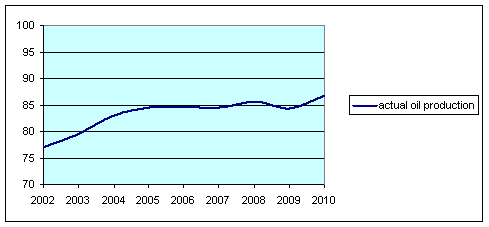
It seems like oil production is on average rather stable, while prices are not.
*


Total global oil production, in millions of barrels per day, annual 2002-2010 (data source: EIA)
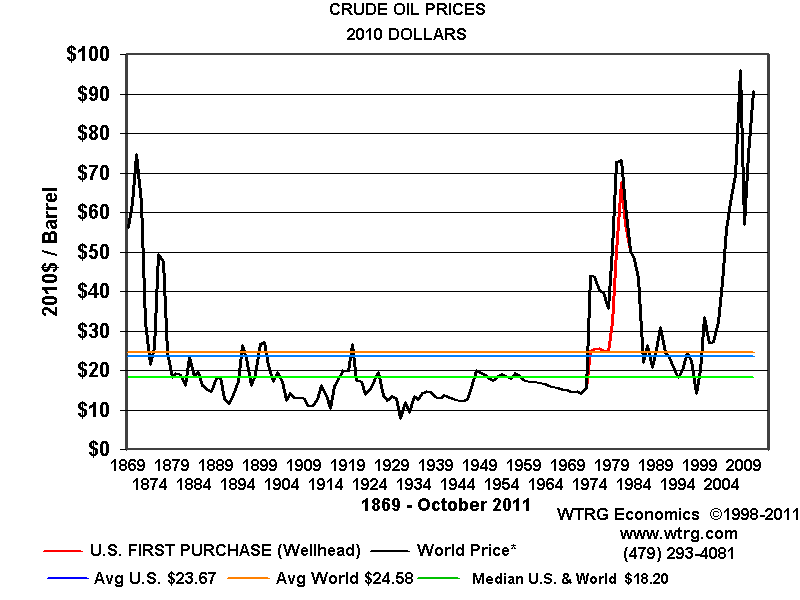
With an economy at full swing, the demand for oil grows and so do prices, as production lags. If suddenly oil prices go up, there is a problem. More fuel economical machines are not installed on the spot: the demand for oil stays fixed until some buyers drop out of the market and essentially close shop: a crisis. Prices of products go up, demand for products goes down: crisis. Less demand for fuel.

Also when oil production is under thread (you know, the Middle East), prices will skyrocket, with a serious risk of a recession. As oil production is not very flexible, prices will go up suddenly and come down crashing.

The roller coaster ride in the price evolution are a systemic risk to the global economy. But also to the national economy and the household. I did not do any simulations, but it seems reasonable to put that the economy would be able to hum on more nicely at a predictably and steadily rising price.
This calls for a policy by the government to protect the economy by diminishing the risk posed by petrol price peaks.

Peak oil and global warming.

So what do we do?

We can chose to ignore global warming AND ignore the whole peak oil debate.

In the case of global warming, this will probably not help, as the scientific consensus on it is quite huge and, moreover, if you visit the Alps you can see the glacier’s decline. At a certain stage the warming will impose itself. it will be way to late to stop any of it, but in any case, there will be a need for investments in air-conditioning, roof insulation, storm and water works. Meanwhile, we could expect the oil prices not to come down at the 20 US$/barrel anytime soon, as the whole world seems to be getting out of poverty. With a fast growing demand, even with unlimited reserves, it will be difficult to pump fast enough. As most of the oil sits in dangerous countries, the current roller coaster of prices seems to be inevitable.

A policy trying to limit the impact of oil shocks would even in this case be good policy. Just drilling more would not change the prices a lot, but making the economy as a whole less dependent on oil, or energy if possible, would. What are these measures? The same as what you would do if you believe in global warming.

What kind of society?

If we know global warming is coming and oil prices are expected to go up, an active policy to go for oil and coal independence is urgent.

With the current technology, it might be possible to nurture decentralised systems or go for evermore centralisation. Solar panels on the roof or fusion energy.

Or we could hedge our bets. We don’t want to nuclear power providers get into a powerful position like the Arabs are, so the development of more diffuse power production is a necessity to balance the centralised powerhouses.

Indeed, big oil, big energy and big finance have a similar track record. They wield enormous power. They are able to resist reform, even if the systemic risk becomes too high. Democratic control is often failing.

Concluding, as any response to the increasingly unstable petrol prices will take time, I would agree with Paul that the first ten years of Peak oil will be rough.

The Black Rabbit and Permaculture

I have been very quiet on my blog lately, as I was totally absorbed by my garden. It is the first time in many years I am living in a home with a real garden where I can grow my produce and I enjoy every minute of it. As I vaguely remember being an agricultural engineer, with some solid experience with small-scale farming systems in Latin America and Africa, I was excited to get on with it. although I must admit that there has been a lot of sowing and growing, but not yet a bountiful harvest.Apparently, the thinking in agriculture from those traditional smallholders has seeped into me. Central is the quest for maximize the use of available resources (land, harvest residue, water) instead of just keeping them organised. .As leeks will be far apart for most of their growing season, why not growing radish, cress or even carrots in between them? Can I diminish the evaporation from the beans by growing a row of corn around them? Mulching with lawn clippings or with wood chippings? What about damage of blackbirds, snails, slugs, Cabbage whites?
Why should I grow dwarf beans when I can have beanstalks? I am also trying just to accept my loss when plague strikes, and apply some tricks to save water. The limits of my environment show starkly, and I should get some pesticides or fertilizer if I want to get really impressive results. But why should I.  I enjoy the constant experimentation, without a trace of RCT.Just now I learned that there seems to be a movement applying these central-African approaches: permaculture.

However, this kind of thinking doesn’t go down well in my more traditionally minded environment. My chaotic patches of multiple-layered inter-cropping systems are just not done. Uniform plots wit mono-cultures and straight lines are the rule.

On top of this new obsession with gardening, I started to sport again, as my tendonitis finally abated. No marathons for me any more, but I am building up to do some “sprint triathlons”. OK, that is only one eighth. This morning I was biking on a lonely bike-path along the canal, when I was surprised to see the rabbits lost all their fear for cyclists. It was there I saw the Black Rabbit. Just one black rabbit among its grey brothers and sisters. It might be the one who got away. Perhaps the group has lost the “wild”factor through interbreeding with tame animals. I wonder what will happen when the hunting season arrives. Although, I guess humans don’t hunt from bicycles.

Galileo Day Campaign: 29 February 2012

Reposting, because it only gets more actual:

The day to celebrate the Earth and Science

Leap day is the single day we all think about our place in the universe, and how we know that place; it honors the earth we live on and our knowledge of the science of nature.

This is why we propose to baptize the 29th of February 2012 “Galileo Day”: a day of wonder about the beauty of the universe around us. A day to recognize the benefits of science and of the scientific method. Finally, a day to honor the individuals who stand up for what they know is true. As Galileo Day or Earth Moves (Us) Day, Leap Day could eventually become a public holiday.

Now that the last leap day has sped us by, it is the right moment to launch this campaign as it is important to start early. There is still time to weigh the pros and cons of such a day without the need to rush. A day with a message Leap day is the single day where we all think about the workings of the world in the wider universe. Every person using the Western calendar will pause at least once during this day and contemplate the orbit of earth around the sun. An orbit that takes a year, that cannot be exactly divided in a number of full earth days. It is the day every person is just a bit proud that He Understands His Position on a Moving Object in Heliocentric Space, contrary to flat-earthers or geo-centrists, who share, in our mind, a place next to Neanderthals and other extinct species.

Predicting seasons is a practical skill

In the tropical hunter-gatherer societies, seasons came and went, and many of these societies used the lunar year rather than the solar year. It was rather the approximate onset of the seasons than the possibility to predict them with precision that counted. However, agricultural societies or seafaring communities, were very keen on predicting when they could expect the seasons to come. The agricultural societies tended to follow a calendar that follows the movements of the sun, and the skill of predicting the seasons was held in high esteem. Priests and scientists are the custodians of this lore, and we are still in awe of the skills of the Egyptians, Mayans, and Chinese in calculating the calendar and the orbit of the stars.

It is difficult for 21st century city dwellers to grasp the urgency of the precision and difficulty to calculate the calendar up to the accuracy of the need for a leap day. Over the lifetime of a person of 60 years, leap days make a difference of maximum 15 days, while the onset of spring or the rainy season varies by more than 10 days from year to year. In regions with a limited growing season for agriculture, 15 days can mean the difference between life and death. Only through indirect astronomical observations is it possible to define the length of the year precisely. The calculation of the calendar was a practical science for early agricultural societies. However, with the accumulation of scientific knowledge, it became apparent that the reality, as perceived by the direct senses or passed down the generations, did not correspond with the newly acquired powers of observation.

The Greek seafarers and travelers already knew that the earth was not flat, but round (spherical). Near the end of the middle ages, improved observations led Copernicus to propose a new world order, with the Sun in the middle, and the Earth in orbit. As this information initially only travelled in a small circle of intellectuals, this view did not stir much opposition.

E pur si muove! And yet it moves!

This changed when the Renaissance broadened the impact of ideas: hunger for knowledge and science was boosting progress all over Europe and this knowledge was spread more widely. One of the better known proponents of the Renaissance is Galileo Galilei. Galileo was a devout Catholic all through his life. He was a typical renaissance man and well-rounded scientist: a philosopher, physicist, astronomer, and above all, the one considered as the father of the scientific method. He worked from a hypothesis, he tried to test his hypothesis through rigorous experiments, and was ready to accept the results of his experiments instead of his own cherished ideas.

Galileo improved the telescope, invented in the Netherlands, and soon became one of the leading astronomers of his time, able to disprove some long held views of his contemporary scientists. When this public figure gave his full support to the findings of Copernicus, placing the sun in the center and the earth in orbit, his enemies, who had suffered defeat arguing against him on other scientific issues, started a campaign against him. According to some of the clerics, heliocentrism, putting the sun in the center of the universe, was contradictory to the Bible and thus heresy. Galileo took Augustine’s position on the Bible: not everything was to be taken literally, even more so when the passages were meant to be poetic or symbolic. This campaign, like a modern press-smear campaign against a public figure, and the subsequent trial, forced Galileo to recant his position on an object orbiting around the sun. We are talking about the inquisition here, and he was probably glad to make it alive. According to popular legend, Galileo muttered after recanting his theory: and yet it moves…. Recognition of the beauty of the world and the benefits of science Indeed, it still moves us, the earth, spinning around its axis, spinning around the sun and around the center of the Milky Way. Galileo died in 1642 and in 1758 the Church authorized the full publication of Galileo’s work. The acceptance of the Copernican world view was postponed, but as it was grounded in reality, observation and scientific method, it prevailed. This is not the story of faith against science, it is the story of jealous competitors bringing down a brilliant man through a public campaign based on prejudice. And ultimately, the scientific method prevailed, but at a huge personal cost for the involved individual. While Galileo was banned from public life, he wrote what is now considered to be one of the main works of physics ever, and the basis of the work by Newton and others. He is known as the father of modern science, while his enemies can be said to be the at the origins of the tabloid method of justice.

Leap day, Galileo day, a day to celebrate the Earth and Science

29 February 2012: Galileo / Earth moves day. We would like to propose to baptize the 29th of February “Galileo Day”: a day of wonder about the beauty of the universe around us. A day of recognition of the benefits of science and of the scientific method. Finally, a day to honor the individuals who stand up for what they know is true.

In the schools, it would be good to highlight on this day the history of the human knowledge, and the facts on our position in the universe. Scientific institutions should certainly take a day off, and governments should allow their personnel to attend to Galileo day celebrations. Post Scriptum:

Definition of Galileo Day

The 29th of February. A day of wonder about the beauty of the universe around us. A day of recognition of the benefits of science and of the scientific method. Finally, a day to honor the individuals who stand up for what they know is true.

Call it a day

Leap Day would be a logical name, as it is already in use. However, does it speak sufficiently to the imagination? Galileo Day seems rich with images and meaning (like Columbus Day). However, Galileo is very much part of the Western heritage, and the meaning of this name might be lost beyond the people educated in the fine print of European history. Earth Moves Day is nice, but could be confused with Earth Day, held on the spring equinox or the 22nd of April. Another option would be to allude to the centripetal force that holds us in place, and go for Rodaytion.

For now, as one of the editors has just finished a divine pasta dinner accompanied by a superb Italian wine, Galileo Day is the favorite. However, we are open to support another name, depending on the quality of the associated food and drinks.

Sunday Paper – New Years’ edition

  • “Sunshine: at the IMF, of all Places”Economist’s View; A new paper argues that the best solution to a financial crisis like the one we just experienced is to increase the share of income going to labor: Sunshine: at the IMF, of all places, by Alex…
  • Where Does Hate Come From?Economist’s View; Daniel Little has a question: Hate as a social demographic : Every democracy I can think of has a meaningful (though usually small) proportion of citizens who fall on the extreme right by any standard: racist, White supremacist, hateful, anti-immigrant, anti-Semitic, anti-Muslim, nativist, nationalist, or violently anti-government individuals and groups. In the United States we have many, man…
  • Palestinians Must Be Free – By Ambassador Maen Rashid AreikatForeign Policy; Ignore the smoke screen thrown up by Israel and its apologists. The real reason for the lack of an enduring Mideast peace deal is the Israeli occupation.
  • The march of freedomAid Watch; All men are created equal. Except blacks. Except women. Except gays. American history shows the erosion of the Excepts, although never complete. Yesterday’s repeal of Don’t Ask, Don’t Tell was another small victory for freedom. Let’s celebrate, while never losing resolve to keep moving towards complete equality and liberty for All. Why even homophobes should celebrate gay rights victoriesAid Watch; One of my favorite Abraham Lincoln quotes: As I would not be a slave, so I would not be a master. This expresses my idea of democracy.If I claim the right to deny you rights, that sets the precedent…
  • Freedom from fear: Protecting people from one of the world’s most brutal rebel groupsFrom Poverty to Power by Duncan Green; Maya Mailer, Humanitarian and Conflict Policy Advisor Across central Africa, men, women and children live in fear of the Lord’s Resistance Army. This predatory group attacks women as they perform their daily tasks – fetching water or tending to their fields – and children returning from school. It abducts, mutilates, rapes and kills, using extreme violence against the most vulnerable. Surviv…
  • Assessing Humanitarian AidGlobal Development: Views from the Center; A lot can be said against the methodology DARA uses, and even against the results they publish (honestly, New Zealand doing better than the Netherlands?). However, the index is necessary and useful. Subscribing to principles, without creating a cost to the non-compliance is moot. DARA makes it worthwhile for a donor to comply, as non-compliance leads to dismal scores. Countries should get more detailed feedback, as they need to be able to explain the problems caused by the methodological issues, and address those that are caused by the lack of motivation to comply with the undersigned principles.
  • Local politics a tough nut to crackChris Blattman; Donors push “community driven development” programs largely to strengthen local institutional capacity, democracy, and inclusiveness. (Sometimes overlooking the fact that these three goals are not…
  • Development Policy Review, Theme Issue: Aid, Institutions and Governance – What Have We Learned – Resources – Overseas Development Institute (ODI)www.odi.org.uk; As part of ODI’s 50th anniversary celebrations, DPR has republished nine key articles in the field of aid, institutions and governance, with an introductory essay by former Editor David Booth.

Sunday Paper

Some articles to remember:

The Sunday paper

  • The Climate Catastrophe Trail Leads to Our Doorstep – Believe It | David Wheeler | Global Development: Views from the Center
  • Promises promises: When politicians don’t deliverThe Essential Read Every politician knows that the key to winning elections is to make great promises. Campaigners promise to cure the ills of society including taxes, war, government corruption, and pollution. Instead, if elected, they will bring about vast improvements in education, employment, infrastructure, and the economy. The size of the elected office seems almost correlated with the size of the promise….
  • Why Have Mobile Phones Succeeded Where Other Technologies Have Not?Global Development: Views from the Center By Jenny Aker – A few weeks ago, I was sitting on a panel for a conference on Information and Communications Technology and Development.  The debate on my panel was a lively one, and came down to one issue:  Can information technology (by itself) lead to development?  Obviously there has been a lot of buzz about this topic
  • Succeed in Kindergarten, and You’re Set for LifeAid Watch. Horizontal axis: Kindergarten test scores; Vertical Axis: Earnings of Same Individuals at Ages 25-27 This blog has discussed how ancient history of countries and peoples affects development today. Now a new paper shows that your own ancient history also matters: your scores on Kindergarten tests are a good predictor of your earnings as an adult, along with other good adult outcomes. Raj Chett…
  • QuODA Moving ForwardGlobal Development: Views from the Center. By Rita Perakis – We’ve been getting a lot of feedback on the Quality of ODA (QuODA) assessment.  This post from the Development Policy blog shows how donor agencies can use our web tools to compare themselves against their peers and identify strengths and weaknesses. We hope readers will continue to use QuODA to learn about what constitutes “quality” […]
  • The impact of house demolitions on Palestine suicide bombingChris Blattman. This paper examines whether house demolitions are an effective counterterrorism tactic against suicide terrorism. We link original longitudinal micro-level data on houses demolished by the Israeli…
  • Will the real bottom billion please stand up?Aid Thoughts. Count the poor. They are the ones dressed like Waldo A few years ago, Paul Collier used the term the bottom billion, to describe those living in poor, mostly African countries which had dim prospects for future growth. Thanks to the successful of the titular book, the term became ubiquitous in the development lingo, although it eventually morphed into a descriptor for the poorest billion in th…
  • Voting, misunderstoodSeth’s Blog. This year, fewer than 40% of voting age Americans will actually vote. A serious glitch in self-marketing, I think. If you don’t vote because you’re trying to teach politicians a lesson, you’re…
  • The Illusion Of ExpertiseThe Essential Read. When I was (much) younger, I believed that large multimillion and multibillion dollar companies were engines of discipline, efficiency, organization, and quality. How could they not be and still be as powerful and successful as they were? Then I went to work for one. And then I married someone who went to work for an even bigger one. And we discovered together that most businesses, in fact, suc…
  • Professional!Tales From the Hood. Required Background Reading: 1) New York Times online edition article by Nicholas Kristof, entitled “D.I.Y. Foreign Aid Revolution.” 2) Foreign Policy online response by Dave Algoso entitled “Don’t…
  • Postscript to “How Useful is Humanitarian Crowdsourcing”humanitarian.info. My article on crowdsourcing in emergencies, published on MobileActive last week, received a good number of intelligent comments. I’d like to thank all the commenters, who all raised valuable points that filled in gaps in my critique and helped to focus my thinking. My only regret is that nobody from Ushahidi had the time or […]
  • It Is Not Too Late: Preparing for Asia’s Next Big Earthquake

Can Haiti count on us? Seriously?

To cut a long story short: yes, you should donate to Haiti. How and to whom is a secondary question.

Haiti has touched a raw nerve with the professional aid cynics. A case in point is William Easterly, the champion for more accountability in aid, who is now going out of his way to praise the current wave of solidarity for Haiti.
When a catastrophe strikes the poorest and most vulnerable people in the hemisphere, you just have to help. Whether you help or not tells you who are. Somebody who knows to act on compassion or not? In the face of disaster, other questions are secondary. My main concern is whether Haiti will be able to count on us beyond the first 3-4 weeks or even 5-10 years to get out of the hole they are in.

I’m just a soul who’s intentions are good/ Oh Lord, please don’t let me be misunderstood

I don’t know a lot about Haiti itself, and will refrain from an opinion on specific local organizations. In my profession, I help international Non-Governmental Organizations (NGOs) with certain projects and have overseen international agencies. I have visited and worked with local aid groups in Africa and Latin America. Most of them have a very strong internal moral culture. They take their mission seriously. Money is accounted for internally, although they might externally obscure accounts so that they can use it in ways that they perceive to better serve their mission and organisation. They are also human. Some people do become corrupt, build empires, play games of power, and slack off. Most don’t. Common as they are, any case of corruption in an NGO is a double disgrace, because it’s like stealing from the poor.
If you fund one of the UN-agencies or major NGOs for its core competency, your money will be rather well spent. These organisations are without any doubt more frugal, better focused and more motivated for their work than a lot of private sector and government services. Professionally, I am convinced that for development, only the highest standard of results for money is  acceptable. This means that improvements are always necessary. But we were talking about Haiti.

The first weeks: effective delivery of food, health and other basic services

In the first couple of days, you need search and rescue, first aid and emergency surgery. You need it quickly and professionally. You need everyone who is in the area to rush to the scene and start working. Of course this is not perfectly coordinated. You don’t have time to wait for the results of meetings on all levels. Rush in and don’t waste time. Starting from the moment when there is an appointed coordinator, the teams must just go where this coordinator tells them to go. If this wild rush for to help didn’t happen, lives would be lost. Indeed, most people die in the first day. And after three days, savings become rare. International teams are welcome, but nearly all the people who get saved are saved from the rubble by their neighbors during the first few days. Apparently the all-hands-on-deck cooperation and mutual help is the norm in emergencies, rather than asocial behavior. A joint-relief effort can be a good start to nation-building.
Next priorities are water, food and shelter, while medical attention continues to be important.1 For this kind of “bulk delivery” of aid, small is wasteful, and only clogs up the coordination mechanisms. The big professionals for this kind of aid are known: the Red Cross movement, the multilateral agencies like UNICEF and the World Food Program, and on the NGO side there are humanitarian giants like MSF and Oxfam.
Already after a few days people start rebuilding their life. Rubble removal is a first sign. The ministry of Health, supported by the international agencies, gets more control over the process.
In the case of Haiti, I am amazed that all these different countries,UN agencies, and International NGOs have managed to produce a document within a few days with all their planned activities for the first months: the Haiti Flash Appeal. Now the donors have a good overview on who does what. As most of these actors are accepted by the humanitarian community as decent organisations that can deliver what they promise, nothing stops the individual to pick his beneficiary from that list.
Are these not the moments that make you proud to be human?

Who’s country is it anyway?

The average Haitian has been a victim of his country rather than an actor in it. In other articles this sad history is highlighted. It is a story of dashed hopes and hope-turned disaster, of popular heroes staying on too long as a president and turning into dictators, of families with no other option to survive and exploit the land beyond restoration. The once-lush country is now barren. With lots of poor in it.
What was worrying me in the first week was the lack of even token respect most people talking about Haiti have for the local institutions, the civil society, the elected government and the churches. It is true that the earthquake has destroyed the very heart of the country, but still, every long-term solution will have to be one where the Haitians can take responsibility for their own future. We heard stories of heroic international rescue workers, saving lives. But the thousands of heroic stories of Haitians were left untold.
While the rushed declarations in the first week had more than a whiff of paternalism, the Ministerial Preparatory Conference in Montreal (25th of January, only 2 weeks after the catastrophe) is a document of unexpected lucidity. The government of Haiti gets the leadership role it needs to take. A long-term commitment is pledged by the main donors, based on the needs.

An election is an event, democracy is an institution: of duty bearers and rights holders

However, I still fear for the future. High-level declarations are usually just that, and my view of empowerment is not that it is something that is given by the powerful, but wrestled by powerless.
In his excellent blog, Duncan Greene from Oxfam writes the following:
There is no apolitical option: A disaster of this magnitude is also a political shock. New actors will emerge, old ones will decline, politics will shift. The spontaneous self-help groups that sprang up after the 1985 Mexican earthquake boosted independent social movements and ultimately led to the decline of Mexico’s one-party state. In Nicaragua, the Sandinista revolution traced its rise back to the mishandling of 1972 earthquake aid by the Somoza dictatorship.
Disaster response is not a substitute for politics. Donors won’t solve Haiti’s problems (which of course predate the earthquake), Haitians will. But the way reconstruction is designed could help or hinder efforts to tackle poor governance, mass unemployment, inequality and crime.
The government currently appears largely absent, but power, like nature, abhors a vacuum. New forces will emerge, which may strengthen or radically alter the social contract between citizen and state.
Re-building the country will be a massive effort. A lot of the physical infrastructure can theoretically be built by international enterprises and delivered key-in-the-door. However, the Haitians will still be in the same dire situation, without a dream of a decent life, even with a new hospital without working health services. With Duncan Greene I would plead to keep an eye on the institutions that lead to a better society and with every intervention to take the impact on these institutions into account.
An option nobody mentioned yet, is to tap into the successful institution-building experience of the European Union for prospect member states. Indeed, up to now the success of the EU in building stable economies and democracies from countries for all kind of stripes is remarkable. From Poland to Portugal, From Greece to Macedonia, success was not guaranteed. It is telling that the EU reserves the institution-building treatment for the “near abroad” while for countries far away, elections event management with international election monitoring tourism will do.
Interventions in the third world tend to be just that: interventions. The world intervenes and organizes an event, with massive press coverage and superstars. They call it elections. Preferably presidential elections with winners and losers. While democracy has been a story of creating stronger institutions to restrain abusive individuals, elections and even constitutions are organised to create “strong leadership”. And this is exactly what happens. Strong leaders are seeking a third term, and weak institutions cannot stop them.
Duty bearers and rights holders is UN jargon for very important principles. Poor people have human rights such as education, basic health services and protection against abuse. They will only get these rights if the civil society, the organised “we the people” are empowered to ask for it. The poor are the rights holders. And who are the duty bearers? It is the local government. Indeed, the local government should guarantee the basic rights, and be accountable for it. The same happens with the civil society: the local union or chamber of commerce is the duty bearer for the type of services they give their members. They organize the people to help them demand their rights from the powerful state or private sector boss. The government is the duty bearer, but can outsource the services if need be, e.g. to the church for education, or to NGOs.
Indeed, our aid-giving governments are duty bearers towards their own electorate, not towards the Haitians. This means that in the long run, our governments will push what their own electorate wants, and the feedback from the Haitian whether this is appropriate, will not be taken into account (otherwise our leaders would act against their mandate). International NGOs that don’t respect this dynamic will be more part of the problem than part of the solution. Local paternalistic NGOs, who only deliver services, wouldn’t be helpful in the building of an accountable Haiti. They aren’t duty bearers, and health care becomes a donation from the NGO instead of a right that can be asked from the elected government. This way universal health care is difficult to attain, as a lot of people who could fight for it, already get it. Those falling through the cracks just stay there.

With great power comes great responsibility, what are you going to do?

How fast will we forget? We should mark the date of January the 12th 2011, and every year after to ask for accounts from everybody who promised to help. How much has been spent? on what, who were the intermediaries? was empowerment of the rights holders mainstreamed in all activities? Where did every penny go? Do we get access to the reports and accounts? Is there a systematic evaluation and are there lessons learned? An institution that complies should get more money. Incompetent ones should be exposed. All too often funding decisions come from the heart while the content of reports go to the brain. We must hold our governments and NGOs accountable for the money spent and the promised results.
As an individual, you should feel good about the needs you want to address and the organisation you are going to support. The needs are plenty and most of them are vital. When the normal protection of family and society crumbles, you need shelter, health care, protection against all kinds of abuse, education, work, income…. If you browse the Flash Appeal, you’ll be amazed by the rainbow of needs and the organizations that reflect them. In March there will be an updated version, that doesn’t only focus on saving lives but also emphasizes reconstruction with the government in the drivers’ seat and with the international community as peers, and with more attention paid to local contributers. It is more a structured and coordinated inventory than a top-down plan.
So choose your cause, your quest, and research your partner.
A good place to start this research is here. Different websites (or this and this) track the behavior of organizations. Other websites focus on transparency. I don’t  know the internal workings of these self-appointed watchdogs, but I use them as a web-source, just an element in my research. What bothers me in the lists the US sites have is that they give very little attention to empowerment of the local civil society or elected officials. Do they support well-respected local communities or are they just paternalistic do-gooders? It is a complaint equally heard about official Aid from the US: when all the US-partners and consultants are paid, what is left? How can you be sensitive to the real needs if you have no local partners? I know the Haitian Red Cross supported by the red cross movement has always been there. I know Oxfam has been working for years in Haiti, just like Doctors Without Borders, UNICEF, Catholic relief Services, and some others.
There is a lot of support now, and if you give to an organisation you trust, they might gather more means that they can use efficiently for Haiti. Are victims of other catastrophes less worthy? If you trust the organisation, let them reassign the money to the needs they see as the most urgent. This is what Doctors Without Borders did already a few days after the earthquake: they announced they had enough for Haiti already. Most humanitarian agencies have a “reserve fund” they can use in case of need. These funds can be mobilized within 24 hours after the impact. The juggernaut of all these funds is the Central Emergency Relief Fund of the UN, and money from it can be assigned flexibly. Most UN-agencies and even most NGOs can recieve money from this fund. To donors and the public, most of them offer their own fund you can contribute to without earmarking your contribution to a specific crisis. But don’t let anybody distract you from demanding the results you paid for.
Moreover, if you have any skills, you might consider to contact a decent organization and offer your services. For Haiti or elsewhere. Probably money is more efficient, but as I said before, it tells more about who you are if you give more than just money. For the moment the place is swarmed, and if you don’t have any specialised skills they urgently need, stay away. The rebuilding may take 10 years, so what about 2018? By then you are a certified engineer they will need.  As I said before: can they count on us? seriously?
By Sam Gardner

notes

1 Epidemics rarely happen immediately after an earthquake. Contrary to conventional wisdom, dead bodies don’t cause epidemics, although they do stink. However, mass burials can traumatize the grieving family. Bad hygienic circumstances afterwards, e.g. by the lack of water and sanitation can cause epidemics though.