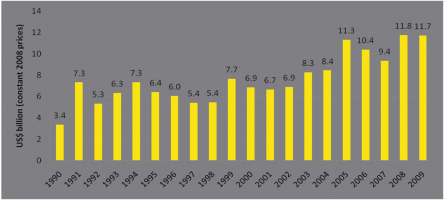
Some important annual milestones for needs based humanitarian donor budgeting just passed: the publication of the 2011 Global Humanitarian Assistance Report and the Mid Year review of the OCHA Consolidated Appeals.
The GHA report analyses the available data on humanitarian funding. It informs you on the reality of funding, in contrast with the fluidity of donor declarations and promises. Donors with a high media visibility might turn out to have low commitments . As an operator in the field, it tells you who funds what where. Compared to other sectors, funding seems to move in a direction where, according to the GHD consensus, more efficient humanitarian assistance is possible. The mid year review gives a snapshot of the needs and funding shortfalls in the different crises, as it is reported through the UN-system.
One of the aims of both documents is to get a better allocation of resources, to have more predictability and better match the donor budgets with the needs.
Indeed, the unspoken consensus on humanitarian assistance is that humanitarian assistance is a moral imperative, a human right, stronger than the “human rights”. When the shit really hits the fan, we will come and help you out. You can count on it. Everywhere. Anywhere. You will get at least what is promised in the Sphere standards. We will not let you sink lower. Your life and dignity will be protected.
Therefore, humanitarian assistance should be organised more like an insurance than like a charity. What is the current mechanics of humanitarian funding, and how is the political economy now, and what should change to become more like an insurance?
The mechanics: The budget cycle
The donor budget cycle starts for most government donors in march of the year before. The first draft of annual (or rolling multi annual) budget is prepared before the mid-year review is received. The only data on needs available are those from the year before. The budget is approved around November in countries with a working government, meaning before Common Appeal is even shared. The input for the budget cycle comes from the common appeal for the year before the budget. Even the review comes too late. The budget cycle is conducive for stable, long term investment in an insurance like scheme, with stable funding.
The mechanics: sudden disasters: the additional funds delusion
When a sudden overwhelming disaster strikes funding of the humanitarian budget is redirected to this new need. Most donors provide with a reserve of 20 % of their budget for sudden onset disasters.
Calls will be placed to liberate “additional funds”. These funds will come in the first place of course from the budgets within the same programme: the allocations for flexible funding or for complex crisis response that was not yet paid in the same year.These other crises will be “forgotten”: all attention goes to the media hog.
If the situation is politically overwhelming, the head of the humanitarian department will have a good hand to fight for additional budgets from other programmes. These will normally be development budgets. Unspent development funds will be transferred to humanitarian assistance. It is extremely rare budgets from outside the development sphere (e.g. unemployment benefits) get transferred to the humanitarian budget for a crisis.
Political economy for budgeting based on sudden disaster spending
This approach leads to an incentive structure for the level of the humanitarian budget that runs against the consensus on humanitarian assistance as a right:
The visibility of complex crisis and predictable funding is limited
The politically experienced needs are mostly in sudden onset disasters.
When it comes to “important crises” the voted humanitarian budget is irrelevant. You could as well accept the need for flexibility, and scrape the money together when disaster strikes. It will make you look good.
The political economy of spending in sudden onset disasters pushes against the principles of Good Humanitarian Donorship and pushes the long term budget provisions down.
Why would you have a high humanitarian budget if you can have a cabinet meeting with media coverage and add from other budgets when there is a political need? In this reasoning, the humanitarian needs are secondary.
It is indeed remarkable that countries with a “presidential” approach to humanitarian spending have lower annual budgets, but also have troops on standby when CNN is filming.
It is normal that the public and even most politicians think humanitarian assistance happens meanly in natural disasters, while in reality 80 % of the funds is spent in complex crises, mostly in civil war zones.
However, something more is at work. I like to call it the incredible moral fibre of the humanitarian donor and agency administration. In some countries, the flexible funding of needs based allocation mechanisms is and stays well funded. Moreover, disaster preparedness and prevention get a good funding, inspite of the political economy.
An alternative approach? Funding instruments
The humanitarian operations by the main actors have moved fast towards an accountable system trying to deliver services according to standards.
Donors should fund instruments that build up reserves and allocate towards the most important needs today in the shifting humanitarian crises. These instruments should be accountable and look for efficiently delivered effectiveness.
There is already an interlocking system with enough redundancy that does just this:
The CERF, DREF and ICRC core funding act as a global system of insurance for humanitarian needs. They can act in sudden disasters and fund forgotten long-term crises.
Most humanitarian agencies have a flexible fund for allocation according to needs. The UNICEF thematic fund for humanitarian assistance, IRA at WFP, SFERA at the FAO, etc.
ECHO acts like one giant needs based fund, with good management practices, oversight and quality control.
There are country level pooled funds and Emergency Response funds.
Apart from funding “needs based”instruments a donor will have to keep some hands on presence in crises that are perceived as important: human solidarity must be done and must be seen to be done. This should not obscure that working through insurance-like mechanisms is far superior when talking about efficiency and effectiveness.
However, there is little political gain in funding these instruments: when the list comes out of donor support for disaster relief, the budget will be spent, and there are no more funds available for bringing your country in the spotlight. Responsible donors and agencies manage however to keep up this kind of funding.
One fund or interlocking systems ?
Politically, the creation of one big fund seems interesting. . It would simplify the message and management for the donors. One check every year. However, in order to have an innovative, learning system, with enough redundancy to pick up the slag when one actor fails, a further development based on interlocking and sometimes competing mechanisms seems indicated.
Insurances need assurances: blank checks or value for money?
However, there is one issue with these instruments: most of them start from the hypothesis that all actors in humanitarian assistance deliver quality and value for money. Comparative evaluations and competitive bidding on value for money are rare. Most attention goes to effectiveness, not to efficiency within a certain quality standard for effectiveness. The instruments for creating instruments for assurance on value for money exist however: there are standards for service delivery and accountability, that could be used for diving prices down and quality delivery up.
These assurances will be the cornerstone towards an insurance-like system
Including preparedness and prevention
Like every insurance, there should be in-build incentives for preparedness and prevention spending, as one of the most efficient humanitarian approaches.
Pushing Good Humanitarian Donorship
The gatekeepers for information should brainwash the politicians and the general public by highlighting the positive contribution of flexible accountable and needs based instruments. The current practices by the main humanitarian actors are more geared towards monetising sudden onset crises, hoping it sticks into the general budget. This should be an active approach, worth a significant portion of the budget.
Some possibilities are obvious:
Ocha should, for every crisis, mention first the contributors to CERF; the same could be requested from ICRC for core and IFRC for DREF. There should be an effort also by teh EU to highlight the importance of flexible funding above ad hoc funding.
Pressure should be as little as possible on “additional funding” the pressure should be to increase the budget for needs based funds. Even pressure for flexible funding to agencies does not have the necessary flexibility to respond exactly to the needs.
The overall budget should be used in rankings. This is why GHA is so important. Rankings per crisis are important, but should be presented always with overall rankings.
To move to an insurance thinking, contributions could be presented preferably as a part of the GNP or per capita, instead of on an absolute basis.
What matters for increasing the humanitarian budget?
An increase in the humanitarian donor budget will not be directly caused by an increase in humanitarian needs. It will depend in the first place on the importance a donor country gives to humanitarian assistance in general. It will be based on the conviction that Humanitarian assistance is a right. It will depend on conviction of the politicians and the general public that assistance should be given more, and that the money is well spend.
This means that the moral case for assistance must be promoted until it becomes a consensus, first in each country, second globally.
It also means that vetting humanitarian partners is necessary. An insurance type of coverage is only possible with decent standards. Standards for service delivery, accountability and evaluation make it possible to compare the operations of the different actors, Multilaterals and INGOs. It does not mean that data or evaluations will convince anybody, it means that those advocating the moral case can do so from the high ground, knowing the tax payers’ money will be well spent.
The biggest enemy for this approach could be the NGO, or multilateral that can make a killing with ad hoc funding.