My dog, COVID-19 and me

I have been working from home since the lockdown. So I wake up, tend my milk kefir (and drink a glass of it), walk my dog briefly in the countryside behind my house where she tries to chase some ducks, and where I make a wide circle around other humans, I feed the chicken (the shed also has some bats living in the roof) and prepare breakfast with some bacon and sourdough bread.

Chicken fleeing human and dog, afraid to catch a bug.


While eating breakfast and scanning the news, I am distracted by articles from people who see their existing opinions confirmed. Biologists talk about the danger of zoonosis (illnesses jumping from animals to humans): the cause of this zoonosis is an encroachment on natural habitats, forcing animals to live amongst people. For others, the wet markets are the cause of the disaster: wild animals should not be hunted or mixed with farm animals. Meat-eating and industrial meat production are blamed, but also globalization, global trade and tourism. Others blame small-scale, unregulated mixed farming for mixing people with animals too closely.  Anti-globalists, Marxists, nationalists and racists have a field day: Coronavirus confirms all opinions. And indeed, all opinions have seeds of truth. A very partial truth.

Me as an ecosystem

As I eat my breakfast and distract myself from having to start work, I think about how I myself am an ecosystem of lifeforms. The symbionts and parasites living in my gut, in, and on my body make me what I am. So far this morning, I interacted with my gut, dog, chicken, kefir, cow, sourdough bread, a bat, and pigs. Each one of them are diverse ecosystems on their own, but also part of the ecosystem that I am.

The ecosystem in my body is in a dynamic balance, and therefore it can fight off intruders quite well. Because there are so many good bacteria, the bad ones have little chance. 

Viruses evolve everywhere, but humans transmit them to me. 

The bacteria in my gut and their viruses can exchange genetic material, making harmless bacteria suddenly lethal. I remember my professor in Animal Health, years ago, referred to E. coli as “mostly harmless”. This was before nasty, virulent, antibiotic-resistant strains evolved. Evolution can also make bugs more useful, better for us, better at fighting off lethal bugs, better cheese, bread, cider. 


I cough in my hand, my dog licks me, and afterwards, I touch my face again. This is what people do. I was more afraid of the humans during the walk than of my dog. I was not afraid of the bat in the shed. While Covid-19 might have started as a zoonosis, now transmission happens mostly from human to human. 

If you get sick from a transmittable disease, you probably caught it from a human. Normally transmission is easier the more similar animals are. The line between zoonosis and transmittable disease is in some way just a classification. Where do you draw the boundary? When tuberculosis evolves within our human community to a multi-resistant strain, savaging the third world, we don’t give it a new name.   

We co-evolve 

When I look at some past zoonosis—Swine flu (pig), SARS (bat), bird flu (chicken, duck), smallpox (cow)—my dog (rabies) and I were having a dangerous adventure this morning. It was Mad Max just to prepare breakfast. 

When I walk in the countryside, there is fresh slurry on the fields, from the pig farm nearby. It creates a primeval soup where all kinds of microbes can grow, interact, and exchange genetic material.

However, I felt safe. I was safe. I am in a shell formed by my own biome, surrounded by protecting shells of increasingly bigger, biodiverse shells. 

Humans co-evolve with zoonotic parasites. Some of these parasites, such as liver fluke, have a life cycle that is just too cool, as long as you are not part of it yourself. Snails in the water contaminate vegetables we eat. In our gut, the parasite moves to the liver and eats it, and the eggs go back to the gut, to the water, to the snail. Toxoplasmosis is a cat-mouse-human story, rumoured to lead to risk-seeking behaviour in mice so cats can catch them—but also in humans, with perhaps half of the global population of humans infected.   

Most zoonoses are mostly dealt with by our standards of ecosystem management.  Wash hands, slaughter with clean material, cook meat, cook veggies, spray against mosquitoes, don’t swim where there are snails. Most of the time, people don’t die. Often, people do die, and then we mourn but have no choice to keep going. 

Our health systems are co-evolving with the bacteria and germs. As long as evolution is gradual, we don’t even notice. But sudden jumps take our health systems by surprise. 

Burning the bat cave. 

Attention goes to where the news is.  Today, we focus on this new viral zoonosis. This one comes from faraway dark places, where unknown wild animals and strange customs combine to frightening and foreign diseases. Humans (them, not us) should stop encroaching on “nature’ and abandon their evil ways. Industrial agriculture, with its massive factories full of monogenetic pigs, fowl, is spawning new and terrible disease. If close contact between pigs and humans gives us the flu, we would be expected to respond by building more hygienic, impersonal meat factories, not family farms with farmers in harmony with cute and cuddly animals. Health and safety regulations are drafted. 

Likewise, if wild animals give us deadly viruses, the expected response is to exterminate them. If we don’t, if we simply put them away in a nature reserve, the danger would always be lurking, dark and ominous. Similarly, before long, we’ll start burning bats in their caves. 

These responses are, of course, based on some truth. The more animals live together, the more chance there is that a virus develops. The more humans live in close quarters, the faster a virus will mutate. And when you mix animals and humans, there are more chances something new will jump.

We live in a world with bugs and bats and pigs and dogs and humans. And all of them bring their own risks and benefits. Benefits for the whole of the system risks for everyone else too.  And all of them also bring a seed of something that can destroy humanity. 

And yet, to have this worldview requires looking at nature as foreign, harmful and dangerous, something we should control and fix. But there’s another way of looking at the same issue, and that is as nature being part of us. And that kind of perspective starts with our own microbiome. 

Lines of defence: Our own biome is the first step, but not enough 

A new pandemic, out of the blue, transmitted from an animal, is not something you care about as an individual. If you look at the important ones: Covid-19, Spanish Flu, HIV-AIDS, Smallpox, The Plague… The chance that they happen is perhaps one in a billion. Nothing for my dog, nor me, to worry about for ourselves. But humanity should worry. The chances are slim that the bug jumps from this bat to me, here, now. A Chance in a billion, but we humans are billions, and there are a lot of animals, so regularly  a jump of a virus from an animal to a human is bound to happen. And once adapted to humans, transmission from human to human is easy.  Yes, there is a low probability, but a pandemic is can be fatal. It is not a relevant problem to me as an individual, but it is an existential risk for humans as a species. So we need lines of defence, as individuals, and as a community. 

Our first line of defence is our biome. Taking care of a diverse ecosystem in my body and around it. This helps us resist disease and build a tolerance. So we should not put nature in reserves and make our homes and the barn totally aseptic. Because, if there is no diversity, and our guards are down, the bad bug will come in roaring like a dragon. Nothing can stop it. 

Knowledge

But there are still risks. We have to know how to keep the sty, stable, and home relatively clean, and we learn to wash our hands. So we start managing our environment, mindful of keeping the biodiversity while limiting the pathogens. 

Homo sapiens is the knowing one. Knowledge is our strength to work with the environment. Stupid approaches are simple: one bug, one drug. Ecosystem gardening can only happen when we know a lot about the bug, a lot about the environment, and a lot about ourselves. Driven by knowledge, we can change our behaviour as a social group. We learn that washing your hands after going into the garden or the farm prevents diarrhea, not only for ourselves but also for our friends and family. We learn that eating enough fibre leads to more stable gut flora. We learn that we can bring down the probabilities, but that we never have iron-clad security. 

So, the human approach for defence is based on the knowledge leveraged by the different interwoven ways humans interact with each other and the environment.

Community action is a second line of defence. The knowledge that we need to stay at home, wash our hands and to keep the social distance is useless if we don’t apply this as a community. We act as a community and wash our hands even if we are not old and frail because communities take care of all their members. 

People keep an eye out and step in when they see newspapers are not picked up, garbage forgotten. Scouts volunteer to do the shopping for the elderly, we organize the bear hunt for the children. The village doctor/health center gives primary care and refers people to hospitals when needed. Community, experience, research and education is the basis of how we can respond to the crisis. 

Collective action at scale

But things can still go wrong. Sometimes a virus still jumps, or something happens that we previously knew little about—a cholera epidemic, for instance. And our community institutions are totally unprepared. Elderly care homes are unable to keep seniors from getting infected, we don’t have the infrastructure to prevent cholera from spreading in the water system. 

As a last line of defence, we need an organized network from the local level to the global level for observation of trends, rapid reaction, research, local, national, and global response. Like a Tsunami warning system, this network must be kept on its toes, even if nothing happens in a hundred years. This is difficult. In the East, the response to SARS led to preparedness for COVID19. In the West, the preparations for SARS were forgotten and abandoned. Do these lines of defence work perfectly? No. But as we did not go extinct yet, they did the job.  

Luckily, globally, the WHO exists, but it should be expanded, given a bigger mandate, and be more accountable. In so many countries all the necessary institutions are in place—they just don’t have the support and safeguards needed to react in time to a pandemic. In some countries, they were curtailed, and a lot of countries cannot afford them. In the pandemic, we help each other, as an individual, and as a country, because we cannot afford to have one going down and affect the others. But also, because we share our humanity. To fight the pandemic there needs to be sufficient trust that we will not be left behind if we do what is right for the global cause, but hurts us today.   

The pandemic is a good example of how society works: humans are individuals and have agency, but they are also part of a community. For every level of risk in this pandemic personal agency is important, but as an outbreak leads to a pandemic and has increasingly more impact, we need to be organized with common purpose at every level of community: the neighbourhood, transparent global research networks, and governments that can promote and impose legitimate collective action, on health care, economy, social distancing and safety nets.    

For those who can’t bother with the messy politics of collective action, escape is the solution: some plan on moving to Mars. It might be a good idea for some, but not for me.

I like to walk my dog in the morning, and I take the risk.
The Olympics I don’t watch

Although I have a  TV, with lots of channels including sports channels , I don’t watch the 2014 winter olympics in Sochi .

Some of my reasons:

  1. I cannot see the athletes I know and I see a lot of coverage to no interest to me
  2. So I lost interest in winter games some time ago, especially as I come from a country with little winter.
  3. The blatant, competitive nationalism it embodies is repulsive to me. Especially because it is not my countries’ nationalism.
  4. The wasteful spending irritates me. The money flows baffle me.
  5. I find the presence of presidents who don’t respect the basic human values abhorrent, and they get airtime before, during and between events as if they had legitimacy
  6. The choices being made on the Olympic games prove that sport is not foremost on their mind.
  7. I did not start yet on the moral reasons why I should not look.

Some additional information on the points

  1. The Olympic Committee is soaked in Stupendous wealth because they sell exclusive broadcasting rights to national broadcasters. In this country, only the national rights holder will have the right to broadcast on internet, cable and air. This means also that they show only the sports and series that are of national interest. As I lived in a number of small countries all over the world, and I am now in another small country, the chances are slim that I see anybody I know. The broadcasting does not incite to internationalism, to the contrary, it narrows the view of the public to only its own athletes, while pretending they look at the “Olympic Games” as they are. As an American you can live with it (most events have Americans).
  2. So every four years, my interest waned a bit more, until it arrived on the current level.
  3. The Olympic games don’t preach a “this land is your land” nationalism. The Olympics, the setup, the presidents and politicians attending, even the publicity, all preach an exclusive, competitive nationalism. An approach of  “us against them”.  It is what researchers call an imagined community. There is nothing that really binds you with those athletes. You don’t know them personally. You don’t know whether they merit to win. You don’t know the story of their competitors. Why, you are probably not even from the same city, so you don’t have a real link with the places where this athlete lives. It is the sort of romanticising of imagined common identities that brought us some very dark moments in our history. Why don’t we compete on other aspects of our identity? Height? Blood group? first letter of our last name?
  4. The wasteful spending irritates me. The main cost of the Olympics falls on countries who are tricked to think it is important (nationalism, investment for future? who knows) to build an oversized infrastructure for sports nearly nobody plays. This is not at all innocent. The economical estimations are questionable. They are also rather financial estimations (looking at cost and benefit) , than economical  (what alternative investments could be made?).
  5. Apart from the athletes, there are also VIPs. Presidents, prime ministers, kings, princes. Apart from the problems with nationalism, I notice some unsavoury figures, who are known for doing “bad” things.  These people distract me from the sports. Did we not create an international criminal court? What baffles me even more is that these people are presented on the same level as the elected leaders of democratic countries that respect human rights. Does this mean that our leaders feel they belong to the same group as these other people? Or do our leaders just bestow legitimacy on them? If you live under one of those thugs, seeing this will make you doubt your future.
  6. In “The Dictator’s’ Handbook” they use the Olympic Committee as an example of an institution gone awry. The way the institution selects its members and leaders, you cannot expect clean governance.  This was so before Sochi. Sochi just brought it to a new level.
  7. This brings us to the moral reasons. These have been quite well covered: according to the Olympic Committee the universal values are subservient to having a spectacular sporting event. Olympics can support leaders, but other leaders should not use the event to criticise, Homosexuality, Chechnya, Pussy Riot, etc.

Any more reasons?


Thinking fast and slow about disaster preparedness

Book: Thinking, Fast and Slow Author: Daniel Kahneman

Getting back to my notes from “Thinking Fast and slow” by Daniel Kahneman, I am still amazed by the diversity of new insights the book provides on how (most) humans think .

Some findings are also relevant for the current thinking in humanitarian assistance on disaster risk reduction (D.R.R. for the incrowd): an important part of the book is dedicated to the human approach to risk, which is not in line with statistical analysis nor economical reasoning.

When talking about risks, the greatest risk seem to be a disaster with a huge humanitarian impact. The book deals specifically with the approach to catastrophic risk by humans, in contrast to the Homo economicus or the statistician. As the political agenda of the humanitarian sector moves towards more investment and more attention to disaster risk reduction and disaster preparedness it might be good to look at his insights. I will heavily rely on quotes from the book.

Humans tend to be very bad at estimating risks and probabilities. We make decisions based on stories, not on a balanced analysis.

“ We pay more attention to the content of messages than to information about their reliability, and as a result end up with a view of the world around us that is simpler and more coherent than the data justify.”

“ Many facts of the world are due to chance, including accidents of sampling. Causal explanations of chance events are inevitably wrong.”

When working in Humanitarian assistance, your mandate is to save lives, alleviate suffering and maintain dignity when the local government is unable or unwilling to act or is overwhelmed. Roughly 80 % of the work will be in complex crises, the crises that are caused mostly by human interaction, like civil war, usually exacerbated by some bad luck on the side of the natural causes. However, it is the big natural disasters, giant floods or tsunamis and earthquakes that catch the imagination. Within the natural catastrophes, there is a rise in small disasters, with a limited number of victims, that is passing mostly under the radar. DRR is in the first place aimed at these 20 % of the investments, as we do now how to prevent natural disasters to become human catastrophes, but do not really know how to prevent civil war.

As humanitarians, we are tempted to argue that you will save more lives by preventing the catastrophes, and so it might be within our mandate after all. But are we sure of this? The question Kahneman asks is: will humanitarians be the right people to judge the importance of investments on disaster risk reduction compared to other priorities for the society (such as the army, education, etc.)

When you do not ignore the very rare events, you will certainly overweigh them.

The humanitarians are focused exactly on the very rare events and it is their explicit job to advocate for increased attention on these rare events. But what happens when we manage to put a risk squarely on the agenda? Some quotes picture a scenario with ever increasing importance to DRR:

Your judgment of probability was ultimately determined by the cognitive ease, or fluency, with which a plausible scenario came to mind. (Disaster risk reduction seems very plausible just after a catastrophe)

Adding irrelevant but vivid details to a monetary outcome also disrupts calculation.(The figures on the risk are intermingled with media pictures of the human suffering during the catastrophe)

The work of disaster prevention is more complicated by the human approach to “worry” and “regret” :

Reducing or mitigating the risk is not adequate; to eliminate the worry the probability must be brought down to zero.

Here again, people buy more than protection against an unlikely disaster; they eliminate a worry and purchase peace of mind.

So how to go about deciding on the importance of risk reduction within the complete spectrum of priorities?

The dilemma between intensely loss-averse moral attitudes and efficient risk management does not have a simple and compelling solution.

Especially just after there was a disaster or a near disaster:

The typical short-term reaction to bad news is increased loss aversion.
The taboo tradeoff against accepting any increase in risk is not an efficient way to use the safety budget.

There is an important risk of overinvestment in disaster risk reduction, leading to a framework that is just not affordable for the country:

The intense aversion to trading increased risk for some other advantage plays out on a grand scale in the laws and regulations governing risk.

Perhaps the humanitarian sector should see themselves just as one actor with a set of specific skills: humanitarian action, perhaps statistics on probabilities and risk analysis. As an inside actor they might be badly placed to take multiple roles and study, plan and finance the DRR approach:

Nothing in life is as important as you think it is when you are thinking about it.

Because as humanitarians we always think about disasters, we are not the best judges when it concerns the allocation of the scarce resources of partner governments or partner communities to DRR. A more humble approach, where the humanitarians leave the planning explicitly to the local partners and only add some seed money and knowledge might be indicated. The world is always risky for the poor, even when there is no disaster: illness, unemployment, accidents, land loss, localized weather phenomena, can be higher on the agenda of the poor family than well known disaster risk.

In summary:

Nothing in life is as important as you think it is when you are thinking about it.

This is also a stark warning for the humanitarian community to keep full attention to the core mandate of saving lives when governments are unable to act. For the moment a lot of the attention is drawn towards DRR away from access, Humanitarian Law and humanitarian delivery to everybody in need. It might be necessary to pay attention to DRR, but it is sure that the focus on it by the humanitarian community has negative effects for the core mandate, as the most scarce resource in humanitarian action is management attention. Is DRR really worth it? It seems to me that this is a political question that should be answered by the local communities, and not by external humanitarian actors.

The hunger games, the Paris agenda and political sciences.

I read the 3 parts of the Hunger Games trilogy in only a few weeks. A book that captivates so well its readers cannot be all bad.

What amazes me most  is how “fantasy”writers seems to be better at captivating the realities of the power relations, social interactions and power impact analysis than the drafters of international agreements, like the Busan outcome document. What is real and what is fantasy?

The silent revolution: is the electric bike a black swan?

The media and the public are staring at the lacklustre growth in the sales of the electrical car, and meanwhile it seems they miss the revolution happening under their nose.

For mobility in the city or the suburbs, the ideal traffic jam-beating device is not the electric car with limited radius. The electric car just solves the exhaust problem, but not the traffic jam. The added value is slim compared to the cheaper gas-guzzlers.

The electric bike extends crucially the use of the bike as preferred option. In a hilly city, biking just becomes this bit easier. For mid-life crisis professionals, it lets you work out without breaking a sweat, while commuting to work. In a clogged city, bikes are as fast as a car. If you feel comfortable biking 6 miles, the electric bike takes you double this distance, to the suburbs, home. This is why some cities do subsidise the purchase of electric bikes. Taking into account the cost of traffic jams and pollution, this is probably a good investment.

The drivers for this change are not the young and chattering classes. It is the silent majority. The pensioners who want to keep getting somewhere while they keep in shape. It are the people who have a house and a family, and start worrying about their health and lifestyle, and the world their kids will live in.

This is the group that normally delivers the momentum for sustainable policy change. Cities on the East coast and the West Coast are getting bike friendly fast, meaning better and faster commutes for bikers . In Europe the infrastructure is changing so fast all over the place that cars drivers are sometimes feeling excluded.

Taking this movement further the electric bike could be a catalyst for livable cities and more concentrated living. Preparing the ground for a quantum leap in carbon economy. The ideal commuter car is a bike. transforming not only the commute in a breeze, but also the suburb and the city in a place with better air, space and green. It takes little space, makes little noise and produces no pollutants. It uses nearly no energy, compared to the competition.

The technology that is still not good enough for cars is very well adapted for bikes. A battery charge brings you easily 40-50 km away, and a recharge is less difficult than with a car. After 80 km of biking, you need a little snack, don’t you? Moreover, the research for cars is bringing fast relief for bikes: better, lighter batteries, faster engines.

The radius of electric bikes makes it the preferred mode of transport for slow tourists in hilly areas, like the Dales or even the Alps.

Already there are more electric bikes than cars driving in China. Up to 30 million bikes are cruising the cities. This creates a mass market, so electric bicycles can be jump-started cheap in the rest of the world. Globally, sales are expected to grow importantly over the next decade. In Europe in some countries up to 53 % of the commuters claim they would be interested in replacing their current commute by public transport or car, by the electric bike.

The most important factor in my assessment is the eagerness the elderly take up the electric bike. Reasonably fit pensioners are the backbone of the electorate in many countries, and the really love their bikes. They will demand their safe roads and bike stalls all over the place.

What do you think?

Busan Aid Effectiveness, Power Impact Analysis and the Rights Based Approach

The use of big words and capitals in capitals

I just used a title where most of the words seem to call for capitalization. It just shows how the development bingo is still in full swing, and we take ourselves so seriously. It is also typical of the kind of message coming from the centralised decision making processes. In development speak: from capital.

Busan has transformed from a city in Korea known from crossword puzzles to a development milestone. I lump this milestone to the latest trend: just like in the sixties we talk about power relations again, power in the sense it was analysed in the Marxist political thinking. Only now this analysis is called political science. The Rights Based Approach is where the empowerment thinking has been hiding while the OECD-led government ownership approach has been running the donor capitals.

Busan Power Impact Analysis

The main gist of Busan is the strengthened “country ownership”. This is good right? It depends of how you see the world. Do you think that countries are people too? Countries don’t have ownership, people in countries have. Who exactly in the development countries and in the donor agencies get more power?

When looking at the Busan outcome document with the instruments offered by the Dictators’ Handbook, we see a document that strengthens the power of the undersigning parties. The reinforcement of the central power, in practice, the president or the minister of finance of the recipient government, is the overarching theme of the outcome document. Now power relations are seldom win-win. More central power means automatically less power for the “others”. From the Handbook (another capitalization) we know that for the Dictator this power allocation is crucial and deliberate. We know also that every leader is a frustrated potential Dictator. This transfer of power to the central recipient’s government seems very risky from the donors’ side if development is the goal and not just international relations. Using the tools from the Handbook, and for the sake of simplicity, it seems like the right thing to conclude that we can use “country ownership” and “wishes of the president” interchangeably.

The Handbook explicitly warns for putting individuals in “gatekeeper” positions, where they can keep everybody else hostage to their designs. Busan promotes this practice and calls it country ownership, while in fact it strengthenes the powers that be, not “we the people”. In a democratic country, this is not a problem, as there are checks and balances. But where exactly the lack of democracy is the problem (as is underlined in the rest of the outcome text), this principle can be expected to block every democratization effort.

Now why would the donors do this? Different hypothesis can be construed and accepted or rejected using the Handbook’s tools:

  1. The objective of development assistance is not helping the poor but advancing the interests of the donor. Meaning of course in the first place good relations with the recipient country, trade advantages, and the odd joint public events and lip service to themes dear to the donor’s heart like gender and reproductive health. This reasoning is an example from the Handbook itself.
  2. Donors are just gullible, and really believe third world leaders are there only to help the poorest. As donor bureaucrats have their own politicians too, it seems not realistic that such ideas would get a lot of traction
  3. Donors think that the rest of the Busan document will manage to steer the leaders to better behaviour. This is a plausible explanation, and seems to be confirmed by the circus surrounding the Paris and Busan agenda.
  4. The Busan agenda, like the Paris agenda before, gives a few strong donors a central bagaining position  at the table, and authorizes small donors to be at the high table too to free ride on the tails of the bigo ones without more than a semblance of expertise. This seems a strong argument. The World Bank has a near monopoly of negotiations with the national governments on budget aid issues, with only DFID having some clout to match their capacity in some countries. Smaller donors can play with the big boys without really having much capacity for doing so. Everybody wins.

Arguments 1 and 4 seem convincing, while argument 2 is heavily used for the public sphere and argument 3 keeps the conscientious bureaucrats motivated at their job. Especially for them there is more to Busan than country ownership alone. However, from the Handbook, we know that every conditionality fails that is not enforced automatically. So it will not happen.

A set of additional principles (conditionalities by another name) will guide the actions and might balance the first principle: Focus on results, inclusive development practices, transparency and mutual accountability.

The results agenda has not been the panacea everybody hoped for.  While the MDGs have given a sense of direction, Paris nor Accra have been very useful to promote this agenda. Indeed, results are best measured on the lowest level, while Paris and Accra rather operate on the aggregate level. Measuring aggregate results is not easy. In most development agencies,  there is an important passive resistance against the “results craze”. Moreover there is a tendency of eliminating power elements from the equation. This could lead to a “sustainable poverty” approach: there are some basic MDG results, but not enough to lead to real empowerment of the poor or even of the middle class. Of course if evaluation is serious and integrated in the way things work, there will be a pressure for improvements. The track record is scary: donors in general hop from paradigm to paradigm, with scant attention to evaluations coming too late or leading to doing the wrong thing righter. More importantly, there is a also preference for political re-engineering instead of just correcting practices step by step, often in line with the electoral cycle at the World Bank or in the UK.

Inclusive partnerships are vague. They seem to fit the description of elections under Lenin in the Handbook: there is no real binding process, and it can be used to divide and rule an ragtag of stakeholders.  It authorizes the President, according to his wishes to set up the processes for participation that fits his purpose. Moreover, the “inclusive agenda” on its own is a more complicated concept than it seems. Does it mean that also the powerless, women, poor, minorities should be included? Or does it mean there should be a consensus approach where real challenges to the conventional wisdom (the wishes of the president) can be sidelined? Is there room for oppositional thinking, with genuine representation, or do we have unelected or self-elected groups vying for attention? The way the inclusive partnership approach works in real countries who have been receiving budget aid without having a multi-party democracy, like Rwanda and Uganda, can shed a light on this.

Transparency and accountability to each other is a fun principle. Transparency is nice and does not hurt anybody, but the added value of just publishing the data is limited. I would agree that it could be the basis for the work of different groups in the civil society to put pressure on the President.What works here of course is not the transparency in itself but the documented pressure.  Transparency could also be the basis for the President to know what everybody, including pesky civil rights groups are up to and are funded for. Mutual accountability is a strange concept. Money goes from the donor to the President. Accountability works the other way. As there is no power in the other equations (to the respective citizens, the intended beneficiaries, constituents and shareholders), we can ignore them. However, this principle introduces the “intended beneficiaries” which might be a weak basis for a rights based approach. The principle might also open the door for conditionality on the basis of some form of participation, but this will be very difficult to enforce, as there is no real definition of what accountability to the intended beneficiaries might mean. As we know, with Dictators, just like with children, it is important to be specific on what exactly is expected from them. And they rarely voluntarily part from power.

When moving thorough the rest of the document, all the right noises on democratic governance, anti-corruption, gender, evaluation,  and other issues are made. It also is rather detailed in its requests for data, monitoring and evaluations. At the same time, a strategic comprehensive and planned approach to development as a whole is promoted. In the reality of the field, these streams are rather exclusive: the iterative approach needed for a really inclusive and democratic process with good evaluations along the line, does not go well with comprehensive 5 year plans on a national level. The approach rather leads to what Aid on the Edge calls “ official views”. The different, and often mutually competitive goals and methods of work make the outcome document difficult to enforce and give a lot of room for politickering, except for the central part:

  1. Country ownership (meaning according to the wishes of the President)
  2. Through the promised transparency: full control on what happens by whom where.

Competing paradigms: Human rights based or country ownership based

The paradigm in UN-development activities is a human rights based approach, where rights are owned to individuals. This is why the MDG- approach becomes effective: you check whether any individual baby got its right to life, aggregate data, and check the result, count the children denied their right to schooling. The rights based approach respects country ownership, or rather country responsibility, but the development activities are aimed at the “one and indivisable” individual human rights. Each right has its own advocates fighting for this right, and its own budget for strengthening the advocacy. UNICEF for children’s rights, Oxfam for the right to food, UNHCHR for Human rights, ILO for labour rights, and so on. The wishes of the president are not above the rights of the individual.

The OECD approach is a government centered approach, with a centrally planned or coordinated working method, steered from Paris to Accra and further to Busan. In essence, it does not deal with “aid effectiveness”, although it uses the term, it only deals with streamlining procedures for government to government procedures. The wishes of the President are above the rights. It ignores the fact that, from the french revolution on, every advance in governance has happened by  wrestling power from the government, not by strengthening them. it is the accountability structure that strengthens institutions.

In this sense Busan is a “means oriented approach” although it uses the term “results based approach” throughout the text. The main question is: does Busan support the human rights based approach, which is essentially empowering, or does it work against it? Asking the question for every single intervention under Busan goes a long way to find the answer.

Finally, the Busan Outcome seems to be an effort by the major development players to force a global “official view” on the others that suits their interest. This view will compete with an innovative, evidence based approach to reaching the global “official goals”.


Peak Oil, the problem or the solution?

I was reading the three futures black swan posting by Paul, and wondered whether Peak Oil would really be such a disruption to the way we work. It seems indeed that Peak oil is now mainstream in the public debate, but the consequences of it are rarely thought through. The camps seem to be divided between believers, predicting catastrophe, and unbelievers. Even in the most oil-dependent country in the world, the discussion on energy policy seems mostly superficial. In this it reminds me of the Climate change debate. It seems that there is scant real planning for the future going on, just doomsayers and deniers.

The debate going on, it looks like even normal economic concepts, like demand and offer, are forgotten.

A marginal revolution

Wikipedia defines Peak oil as the point in time when the maximum rate of global petroleum extraction is reached, after which the rate of production enters terminal decline. I would like to use a different concept. The peak production as defined above depends on the price, and we could imagine prices to be higher, so much higher that a lot of now uneconomical fields go into production. So “ peak oil” is in fact only defined at a certain price. Of course, in the end production will eventually have to go down, but it will go down first because extraction is not cost effective at the price people are ready to pay for it, not because there is no oil left anymore. In the end, oil will never run out, only the price will rise so high nobody will buy it anymore.

For this blog, I will use the definition of peak oil as the price of oil where major alternatives become as viable as oil itself. Within this definition, peak oil is reached for different uses at different prices. Taxes and subsidies are equally part of the picture.

Most of these alternatives need investments and constant demand, making them a bad bet when prices are just fluctuating, leading to peaks and troughs in demand for the new resource (while for oil these investments are in place). It is not worth investing in the alternatives that risk to be uneconomical for most of the years to come. However, once the prices move to a long term high, the picture changes.

For home heating, peak oil is already reached: for a price of 100 US$ a barrel, it is apparently worthwhile to build a passive house in a temperate climate, as people are doing so in droves. So the energy bill of the house for heating becomes approximately zero. You only have to calculate the depreciation of the system. Even for older houses, insulation is cutting the bill with up to 3/4. The move from petrol-based heating (gasoline) to gas or even heath pumps (nuclear) is general, thanks to a little subsidy left or right. Indeed, this is taking into account the subsidies, but as heating oil in general is not taxed like other goods, this argument cuts both ways.

For decentralised electricity production the use of solar power in sunny countries with a low cost of roof space and a high cost of energy transport, might already be reached. Wind energy is not far behind. When prices are high, the use of bio-fuels seems to be economical in countries with a good year round vegetable production potential.

For centralised electricity production nuclear energy seems to be an alternative I am reluctant to support, and as much as a loath it, coal is still around.

For fueling cars the production of bio-diesel based on palm oil seems to be economical at high price points (perhaps 120 USD/barrel, we saw it already happen a few years ago), but in the long run the use of electricity as a plug-in option for hybrids or as a full electrical option seem relevant. The problem with electricity seems to be more the infrastructure and the upfromt investment cost than the economical use of energy (just like with the passive houses). Indeed, if highways would be standard providing a “third rail” like for subways, we would be wondering who authorized the use of dangerous inflammable technology like the internal combustion engine.

Overall, there are many alternatives for oil, and more to come, each of them economical from a different price point. The most promising for the moment is energy savings (house insulation, less consuming cars, less car use, etc.). However, as prices rise, innovation will explode.

In the long run, under constant incentives from prices and government propaganda, the silent hand of alternative choices shows up: what about changing a house with 4×4 in the countryside for an apartment in a livable city and all the money for holidays you can imagine? What about just using a plastic case instead of aluminum?

Lack of price elasticity is worse than high prices.

For the moment, the price of energy is linked to oil: the other energy sources, coal, nuclear energy, wind-energy, bio-fuel, solar energy, sell their energy on a market where the price is more or less set by oil.

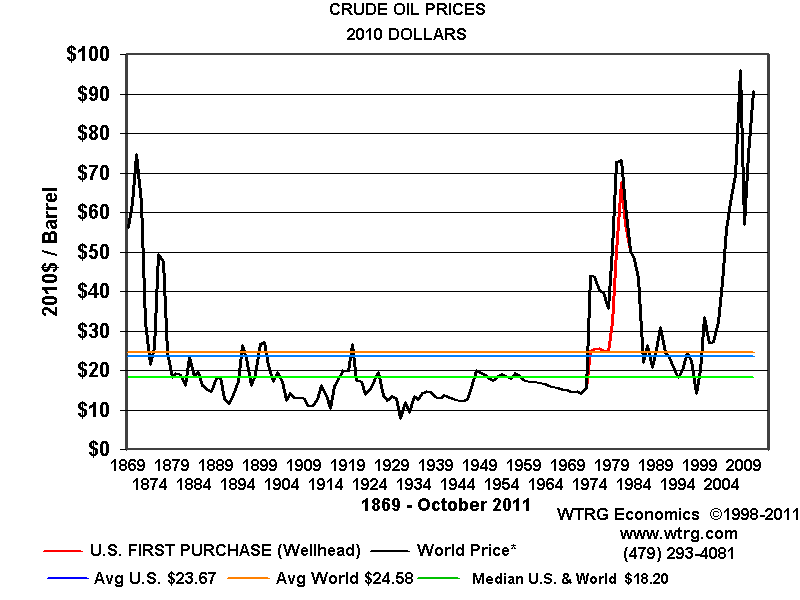
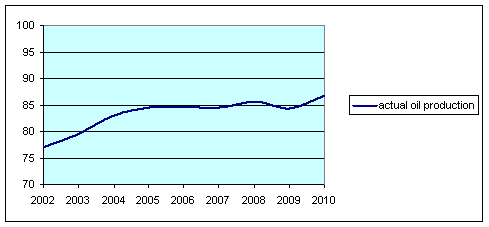
It seems like oil production is on average rather stable, while prices are not.

*


Total global oil production, in millions of barrels per day, annual 2002-2010 (data source: EIA)

With an economy at full swing, the demand for oil grows and so do prices, as production lags. If suddenly oil prices go up, there is a problem. More fuel economical machines are not installed on the spot: the demand for oil stays fixed until some buyers drop out of the market and essentially close shop: a crisis. Prices of products go up, demand for products goes down: crisis. Less demand for fuel.

Also when oil production is under thread (you know, the Middle East), prices will skyrocket, with a serious risk of a recession. As oil production is not very flexible, prices will go up suddenly and come down crashing.

The roller coaster ride in the price evolution are a systemic risk to the global economy. But also to the national economy and the household. I did not do any simulations, but it seems reasonable to put that the economy would be able to hum on more nicely at a predictably and steadily rising price.
This calls for a policy by the government to protect the economy by diminishing the risk posed by petrol price peaks.

Peak oil and global warming.

So what do we do?

We can chose to ignore global warming AND ignore the whole peak oil debate.

In the case of global warming, this will probably not help, as the scientific consensus on it is quite huge and, moreover, if you visit the Alps you can see the glacier’s decline. At a certain stage the warming will impose itself. it will be way to late to stop any of it, but in any case, there will be a need for investments in air-conditioning, roof insulation, storm and water works. Meanwhile, we could expect the oil prices not to come down at the 20 US$/barrel anytime soon, as the whole world seems to be getting out of poverty. With a fast growing demand, even with unlimited reserves, it will be difficult to pump fast enough. As most of the oil sits in dangerous countries, the current roller coaster of prices seems to be inevitable.

A policy trying to limit the impact of oil shocks would even in this case be good policy. Just drilling more would not change the prices a lot, but making the economy as a whole less dependent on oil, or energy if possible, would. What are these measures? The same as what you would do if you believe in global warming.

What kind of society?

If we know global warming is coming and oil prices are expected to go up, an active policy to go for oil and coal independence is urgent.

With the current technology, it might be possible to nurture decentralised systems or go for evermore centralisation. Solar panels on the roof or fusion energy.

Or we could hedge our bets. We don’t want to nuclear power providers get into a powerful position like the Arabs are, so the development of more diffuse power production is a necessity to balance the centralised powerhouses.

Indeed, big oil, big energy and big finance have a similar track record. They wield enormous power. They are able to resist reform, even if the systemic risk becomes too high. Democratic control is often failing.

Concluding, as any response to the increasingly unstable petrol prices will take time, I would agree with Paul that the first ten years of Peak oil will be rough.

Admitting Failure: Join the Posse (Only for real Men)

I am all in favour of evolution in development practice and thinking, where normally, it is more important to cull downright dismal failures than to select only the best, as evolution needs variability to work its magic.

Admitting mistakes or difficulties is also part of every professional relationship between partners. Part of the reputation of ICRC is generated by its tendency to speak rather bluntly about its own capacities in private, while the toeing of the party line by the staff of other organisations (say UNICEF) lessens the confidence in the organisation. However, when looking at the public image, it might be the other way round. It might seem that, when you need direct funding from the broader public, admitting failure is not the best practice.

I have some serious questions on the trend to focus on admitting failure. I will focus on elements:

  1. Who can admit failure?
  2. What does this failure say about the respect organisations have for beneficiaries?
  3. The posse rides again, where do we ride it to?

Who can admit failure?
When I look at who is leading the charge in “admitting failure”, it seems to me that big failures can be admitted by organisations who interact mostly with a more sophisticated donor public: governments (World bank) or better informed people (who supports engineers without borders?). For these organisations it seems to me to be fully in line with the analysis of Marc: it is just something to run with the posse, without a real cost. It is signaling credibility. However, if they need a separate thematic line to treat with failure, what have their (transparent) evaluation and monitoring departments been doing until now? An aspect that cannot be addressed with the failure approach is the recognition that systems are inherently complex.

When other organisations publish failures, it is closer to a “lessons learned” story: we know this works, we applied it there, we overlooked this element, it did not work). What is being talked about by these organisation is not failure, but evaluation and short feedback loops, in order to be able to correct early in the project. Small NGOs don’t have official evaluation strategies, they just learn their lessons the hard way, and take them on board.

Admitting failure looks very much like extremely badly conceived monitoring and evaluation when described this way. Indeed I fear this failure posse might interfere with the other posse towards professional and transparent evaluation and results measurement. The World Bank should know better.

Please some respect
The stories about failure often describe projects that were implemented and afterwards it seemed not to work, because of a simple aspect not taken on board. The Merry-go-round water pump is the case in point. I notice that the evidence base of this project was weak, and implementation at a large scale happened before a decent assessment was made.

This echoes the discussion on the Millenium Villages in the Guardian where do-gooders rush into implementation of everything they think will help the villagers, claiming it would be immoral to let them wait until an evidence base is established. I sympathise with them, but a minimum of monitoring must be possible between a pilot or startup phase and full-blown execution. Of course, the victims of all this activism are poor, and poor are by definition powerless. The organisation can just move on, looking for fresh victims. There are enough of them : “the poor will always be with you”. With enough failure, we can assure they stay that way.

The posse rides again: where to ?
Failure looks to me like the spin off from a good tendency. The tendency to professionalism, to stop looking at the world as it should be, but as it is. The need for evaluations and feedback loops. The need for research and evidence base. The need to document what works and what not. Part of this professional approach is that failure is just another piece of transparent information from every actor.

However, like we saw the “program approach” coming instead of making good projects, it might be that the Posse on Failure attracts more riders than the one of professional information and risk management.

Galileo Day Campaign: 29 February 2012

Reposting, because it only gets more actual:

The day to celebrate the Earth and Science

Leap day is the single day we all think about our place in the universe, and how we know that place; it honors the earth we live on and our knowledge of the science of nature.

This is why we propose to baptize the 29th of February 2012 “Galileo Day”: a day of wonder about the beauty of the universe around us. A day to recognize the benefits of science and of the scientific method. Finally, a day to honor the individuals who stand up for what they know is true. As Galileo Day or Earth Moves (Us) Day, Leap Day could eventually become a public holiday.

Now that the last leap day has sped us by, it is the right moment to launch this campaign as it is important to start early. There is still time to weigh the pros and cons of such a day without the need to rush. A day with a message Leap day is the single day where we all think about the workings of the world in the wider universe. Every person using the Western calendar will pause at least once during this day and contemplate the orbit of earth around the sun. An orbit that takes a year, that cannot be exactly divided in a number of full earth days. It is the day every person is just a bit proud that He Understands His Position on a Moving Object in Heliocentric Space, contrary to flat-earthers or geo-centrists, who share, in our mind, a place next to Neanderthals and other extinct species.

Predicting seasons is a practical skill

In the tropical hunter-gatherer societies, seasons came and went, and many of these societies used the lunar year rather than the solar year. It was rather the approximate onset of the seasons than the possibility to predict them with precision that counted. However, agricultural societies or seafaring communities, were very keen on predicting when they could expect the seasons to come. The agricultural societies tended to follow a calendar that follows the movements of the sun, and the skill of predicting the seasons was held in high esteem. Priests and scientists are the custodians of this lore, and we are still in awe of the skills of the Egyptians, Mayans, and Chinese in calculating the calendar and the orbit of the stars.

It is difficult for 21st century city dwellers to grasp the urgency of the precision and difficulty to calculate the calendar up to the accuracy of the need for a leap day. Over the lifetime of a person of 60 years, leap days make a difference of maximum 15 days, while the onset of spring or the rainy season varies by more than 10 days from year to year. In regions with a limited growing season for agriculture, 15 days can mean the difference between life and death. Only through indirect astronomical observations is it possible to define the length of the year precisely. The calculation of the calendar was a practical science for early agricultural societies. However, with the accumulation of scientific knowledge, it became apparent that the reality, as perceived by the direct senses or passed down the generations, did not correspond with the newly acquired powers of observation.

The Greek seafarers and travelers already knew that the earth was not flat, but round (spherical). Near the end of the middle ages, improved observations led Copernicus to propose a new world order, with the Sun in the middle, and the Earth in orbit. As this information initially only travelled in a small circle of intellectuals, this view did not stir much opposition.

E pur si muove! And yet it moves!

This changed when the Renaissance broadened the impact of ideas: hunger for knowledge and science was boosting progress all over Europe and this knowledge was spread more widely. One of the better known proponents of the Renaissance is Galileo Galilei. Galileo was a devout Catholic all through his life. He was a typical renaissance man and well-rounded scientist: a philosopher, physicist, astronomer, and above all, the one considered as the father of the scientific method. He worked from a hypothesis, he tried to test his hypothesis through rigorous experiments, and was ready to accept the results of his experiments instead of his own cherished ideas.

Galileo improved the telescope, invented in the Netherlands, and soon became one of the leading astronomers of his time, able to disprove some long held views of his contemporary scientists. When this public figure gave his full support to the findings of Copernicus, placing the sun in the center and the earth in orbit, his enemies, who had suffered defeat arguing against him on other scientific issues, started a campaign against him. According to some of the clerics, heliocentrism, putting the sun in the center of the universe, was contradictory to the Bible and thus heresy. Galileo took Augustine’s position on the Bible: not everything was to be taken literally, even more so when the passages were meant to be poetic or symbolic. This campaign, like a modern press-smear campaign against a public figure, and the subsequent trial, forced Galileo to recant his position on an object orbiting around the sun. We are talking about the inquisition here, and he was probably glad to make it alive. According to popular legend, Galileo muttered after recanting his theory: and yet it moves…. Recognition of the beauty of the world and the benefits of science Indeed, it still moves us, the earth, spinning around its axis, spinning around the sun and around the center of the Milky Way. Galileo died in 1642 and in 1758 the Church authorized the full publication of Galileo’s work. The acceptance of the Copernican world view was postponed, but as it was grounded in reality, observation and scientific method, it prevailed. This is not the story of faith against science, it is the story of jealous competitors bringing down a brilliant man through a public campaign based on prejudice. And ultimately, the scientific method prevailed, but at a huge personal cost for the involved individual. While Galileo was banned from public life, he wrote what is now considered to be one of the main works of physics ever, and the basis of the work by Newton and others. He is known as the father of modern science, while his enemies can be said to be the at the origins of the tabloid method of justice.

Leap day, Galileo day, a day to celebrate the Earth and Science

29 February 2012: Galileo / Earth moves day. We would like to propose to baptize the 29th of February “Galileo Day”: a day of wonder about the beauty of the universe around us. A day of recognition of the benefits of science and of the scientific method. Finally, a day to honor the individuals who stand up for what they know is true.

In the schools, it would be good to highlight on this day the history of the human knowledge, and the facts on our position in the universe. Scientific institutions should certainly take a day off, and governments should allow their personnel to attend to Galileo day celebrations. Post Scriptum:

Definition of Galileo Day

The 29th of February. A day of wonder about the beauty of the universe around us. A day of recognition of the benefits of science and of the scientific method. Finally, a day to honor the individuals who stand up for what they know is true.

Call it a day

Leap Day would be a logical name, as it is already in use. However, does it speak sufficiently to the imagination? Galileo Day seems rich with images and meaning (like Columbus Day). However, Galileo is very much part of the Western heritage, and the meaning of this name might be lost beyond the people educated in the fine print of European history. Earth Moves Day is nice, but could be confused with Earth Day, held on the spring equinox or the 22nd of April. Another option would be to allude to the centripetal force that holds us in place, and go for Rodaytion.

For now, as one of the editors has just finished a divine pasta dinner accompanied by a superb Italian wine, Galileo Day is the favorite. However, we are open to support another name, depending on the quality of the associated food and drinks.

A new year, a new donor budget and the fallacy of additional resources

Donor budgets are annual and modular. The legislation ruling these budgets covers normally all expenditures in all departments. This means expectations on donor flexibility are often unrealistic. While the role of parliaments in poor countries might be taken into account, often the role of donor legislation, parliaments in the donor countries and the limited importance of development in donor country political priority setting are often forgotten.

A budget in most countries is annual. This means a budget starting in January is normally proposed by the desk officer in March, April, balanced for priorities within the hierarchy and government and finally discussed, amended and approved by the parliament around November. The actual calendar depends on the donor. From that moment on, the allocation for departments, programmes, budget lines and even individual allocations is fixed for the rest of the year. Changes are still possible. However, the procedures can be difficult. In most countries, the legislation supports limiting expenditure and makes additional expenditure difficult. At the higher levels, there is a need to go back to the parliament, at the intermediate level, it might be necessary to go to the Chancellor of the Exchequer. At the lower levels, changes might be allowed within the department or even at the level of the desk officer.

Lessons learned:

  1. On the cabinet level, a government decides on the broad strokes. So the only cabinet level decision might be on the total Official Development Assistance budget for the year (allocation is annual, spending might be multi-annual). Within this budget, it is mostly the preserve of the Minister for development coöperation to make allocations.
  2. As most governments don’t allow the printing of money, additional funding for a development issue normally means savings within the same department. “Additional funding” for development is only possible if there is a disaster or other major event that convinces the parliament and the public to change its priorities, by reallocating e.g. national health service budget to disaster relief. There might be a constituency of potential health service clients who would oppose this move. International conferences, resolutions or best practices normally don’t qualify for getting this treatment. Real additional funding would e.g. mean that a government moves its benchmark for development spending up (e.g. from 0.7 % to 0.75 %).
  3. For all practical purposes, “Additional funding” for one development item, like climate change adaptation means to diminish the funding for less sexy development priorities, like primary education, health systems or democratic governance between elections. The call for additional funding is a call to diminish the funding for other development issues. The choices for savings are seldom explicit. How many people should we stop feeding to increase the funding for coördination?
  4. Who pays the piper calls it tune: If it is not on the budget, it is not important. If an item is recognized as a budget line or a programme in the official budget, it is ingrained in the DNA of the donor. Continuity is near guaranteed, even over the years. If there is only an agreement signed to give the item top priority, but there is no dedicated budget, allocation of scarce funding will be difficult. It will depend on the priority the desk officer can impose on his minister for actually paying up. However, being buried in the budget on a lower level might be useful to stay under the radar, e.g. when supporting innovative interventions with low political backing and public appeal.