Thinking, fast and slow and the transparency agenda in development

I was reading “Thinking, fast and slow” by Daniel Kahnemann. It is a very good book. It challenges conventional wisdom and is so full of meaning that it asks for a regular reread to discover more hidden treasure.

He explains how humans actually think, and not just how we think we think. He doesn’t really believe these insights will change anything: he considers it mostly an enrichment for water cooler discussions. As our illogical ways are hard-wired, even when we know we are illogical, we can not help it but to proceed on the beaten path. The Homo sapiens and Homo economicus are 2 entirely different species.

However, this will not stop me from trying to apply some of his insights.

One theme from the book of direct relevance for development work is our relationship with data. I will touch on 2 aspects: how to predict success of an intervention and how to convince people an intervention is a success.

Apparently, a conviction is formed when the story behind the conviction is convincing. Now apparently a story is convincing when it is in the first place coherent. Real life stories however (what some people call the reality) are never very coherent: a lot of things happen that blur the story. People have lots of reasons, not just one, and the one they tell you might not be the one that is relevant. So to be convincing, only the coherent data should be presented. Otherwise, the conviction will be weaker.

The prime example of this effect is of course the diplomatic cable: a coherent and short analysis is explicitly required. Clarity and conciseness are cardinal virtues. A political decision taken on the basis of this kind of analysis will of course be convincing. Meanwhile the simplifications in the analysis yielding to the demands for a coherent story can lead to important errors. Only the elements mentioned in the cable will be taken into account. Kahnemann says: “what we see is all there is”. This might be why sometimes bad choices are made in foreign affairs.

Closer to the development world is the International Aid Transparency Initiative.

The International Aid Transparency Initiative (IATI) aims to make information about aid spending easier to find, use and compare.

Those involved in aid programmes will be able to better track what aid is being used for and what it is achieving. This stretches from taxpayers in donor countries, to those in developing countries who benefit from aid.

Improving transparency also helps governments in developing countries manage aid more effectively. This means that each dollar will go as far as possible towards fighting poverty.

From what was explained above, we understand that the transparency towards the taxpayers will not lead to more trust in the expenditures and trust in the whole venture of development aid. To the contrary: the full exposure to all the data will probably lead rather to more distrust, because the simple story we need to convince of the good aid does, will get complicated. For every straight success story, there will be more lots of maybes, and too many unfortunate failures. Full disclosure is perhaps necessary for moral reasons and to keep the practitioners honest, but will not lead to more trust by the public.

More to the core of our work is how we predict the success of an intervention. Experts, it seems, can be very good at analysing complex situations, but most of them seem unable to predict what will happen next. His prime example concerns newborn babies. Before, it was the gynecologist who would decide how to care for the newborn. When they started to base the decision on simple indicators that can be gathered by every nurse, infant survival started to improve. Apparently, when the feedback loop is not immediate, statistics and simple indicators are more accurate in guiding what to do than experts. The anaesthetics get direct feedback from their work, and develop very good gut reactions, less so the gynaecologists when deciding on what to do with the newborn.

This seems to be very relevant for the approval process of projects and other interventions. The approval process is normally a mixed bag of expert analysis and some indicators. The indicators are not really chosen because they predict success, but because they measure political priorities, such as the mainstreaming of women’s issues and environmental awareness.

Experts who analyse projects for approval are seldom around when the results are obtained, and evaluations happen even later, too late to inform the next phase. Moreover, as political priorities shift, chances are that, even when the results are good, attention shifted a long time ago and we won’t continue the project.

This is a typical situation where, according to Kahnemann, expert advice is next to worthless. An alternative should be to use simple indicators that are known from the statistical analysis to predict success.

We know about some of the main elements that can predict success in development: proven interventions (de-worming etc, the whole CRT stuff) interventions done by trustworthy partners, and interventions tackling in a serious way the main issues at stake. Most of these elements are quite straightforward, and could form the basis for a simple analysis based on indicators. But not a lot of elements are available for analysing the substance of the project.

And here the IATI comes in. We just don’ t have the statistics on interventions to go beyond the most simple results predictions. IATI should strive to offer these statistics asap.

Perhaps humanitarian assistance, with its short feedback loop, the urgency to get the results right and existing standards, would be a good place to start.

The hunger games, the Paris agenda and political sciences.

I read the 3 parts of the Hunger Games trilogy in only a few weeks. A book that captivates so well its readers cannot be all bad.

What amazes me most  is how “fantasy”writers seems to be better at captivating the realities of the power relations, social interactions and power impact analysis than the drafters of international agreements, like the Busan outcome document. What is real and what is fantasy?

The silent revolution: is the electric bike a black swan?

The media and the public are staring at the lacklustre growth in the sales of the electrical car, and meanwhile it seems they miss the revolution happening under their nose.

For mobility in the city or the suburbs, the ideal traffic jam-beating device is not the electric car with limited radius. The electric car just solves the exhaust problem, but not the traffic jam. The added value is slim compared to the cheaper gas-guzzlers.

The electric bike extends crucially the use of the bike as preferred option. In a hilly city, biking just becomes this bit easier. For mid-life crisis professionals, it lets you work out without breaking a sweat, while commuting to work. In a clogged city, bikes are as fast as a car. If you feel comfortable biking 6 miles, the electric bike takes you double this distance, to the suburbs, home. This is why some cities do subsidise the purchase of electric bikes. Taking into account the cost of traffic jams and pollution, this is probably a good investment.

The drivers for this change are not the young and chattering classes. It is the silent majority. The pensioners who want to keep getting somewhere while they keep in shape. It are the people who have a house and a family, and start worrying about their health and lifestyle, and the world their kids will live in.

This is the group that normally delivers the momentum for sustainable policy change. Cities on the East coast and the West Coast are getting bike friendly fast, meaning better and faster commutes for bikers . In Europe the infrastructure is changing so fast all over the place that cars drivers are sometimes feeling excluded.

Taking this movement further the electric bike could be a catalyst for livable cities and more concentrated living. Preparing the ground for a quantum leap in carbon economy. The ideal commuter car is a bike. transforming not only the commute in a breeze, but also the suburb and the city in a place with better air, space and green. It takes little space, makes little noise and produces no pollutants. It uses nearly no energy, compared to the competition.

The technology that is still not good enough for cars is very well adapted for bikes. A battery charge brings you easily 40-50 km away, and a recharge is less difficult than with a car. After 80 km of biking, you need a little snack, don’t you? Moreover, the research for cars is bringing fast relief for bikes: better, lighter batteries, faster engines.

The radius of electric bikes makes it the preferred mode of transport for slow tourists in hilly areas, like the Dales or even the Alps.

Already there are more electric bikes than cars driving in China. Up to 30 million bikes are cruising the cities. This creates a mass market, so electric bicycles can be jump-started cheap in the rest of the world. Globally, sales are expected to grow importantly over the next decade. In Europe in some countries up to 53 % of the commuters claim they would be interested in replacing their current commute by public transport or car, by the electric bike.

The most important factor in my assessment is the eagerness the elderly take up the electric bike. Reasonably fit pensioners are the backbone of the electorate in many countries, and the really love their bikes. They will demand their safe roads and bike stalls all over the place.

What do you think?

Busan Aid Effectiveness, Power Impact Analysis and the Rights Based Approach

The use of big words and capitals in capitals

I just used a title where most of the words seem to call for capitalization. It just shows how the development bingo is still in full swing, and we take ourselves so seriously. It is also typical of the kind of message coming from the centralised decision making processes. In development speak: from capital.

Busan has transformed from a city in Korea known from crossword puzzles to a development milestone. I lump this milestone to the latest trend: just like in the sixties we talk about power relations again, power in the sense it was analysed in the Marxist political thinking. Only now this analysis is called political science. The Rights Based Approach is where the empowerment thinking has been hiding while the OECD-led government ownership approach has been running the donor capitals.

Busan Power Impact Analysis

The main gist of Busan is the strengthened “country ownership”. This is good right? It depends of how you see the world. Do you think that countries are people too? Countries don’t have ownership, people in countries have. Who exactly in the development countries and in the donor agencies get more power?

When looking at the Busan outcome document with the instruments offered by the Dictators’ Handbook, we see a document that strengthens the power of the undersigning parties. The reinforcement of the central power, in practice, the president or the minister of finance of the recipient government, is the overarching theme of the outcome document. Now power relations are seldom win-win. More central power means automatically less power for the “others”. From the Handbook (another capitalization) we know that for the Dictator this power allocation is crucial and deliberate. We know also that every leader is a frustrated potential Dictator. This transfer of power to the central recipient’s government seems very risky from the donors’ side if development is the goal and not just international relations. Using the tools from the Handbook, and for the sake of simplicity, it seems like the right thing to conclude that we can use “country ownership” and “wishes of the president” interchangeably.

The Handbook explicitly warns for putting individuals in “gatekeeper” positions, where they can keep everybody else hostage to their designs. Busan promotes this practice and calls it country ownership, while in fact it strengthenes the powers that be, not “we the people”. In a democratic country, this is not a problem, as there are checks and balances. But where exactly the lack of democracy is the problem (as is underlined in the rest of the outcome text), this principle can be expected to block every democratization effort.

Now why would the donors do this? Different hypothesis can be construed and accepted or rejected using the Handbook’s tools:

  1. The objective of development assistance is not helping the poor but advancing the interests of the donor. Meaning of course in the first place good relations with the recipient country, trade advantages, and the odd joint public events and lip service to themes dear to the donor’s heart like gender and reproductive health. This reasoning is an example from the Handbook itself.
  2. Donors are just gullible, and really believe third world leaders are there only to help the poorest. As donor bureaucrats have their own politicians too, it seems not realistic that such ideas would get a lot of traction
  3. Donors think that the rest of the Busan document will manage to steer the leaders to better behaviour. This is a plausible explanation, and seems to be confirmed by the circus surrounding the Paris and Busan agenda.
  4. The Busan agenda, like the Paris agenda before, gives a few strong donors a central bagaining position  at the table, and authorizes small donors to be at the high table too to free ride on the tails of the bigo ones without more than a semblance of expertise. This seems a strong argument. The World Bank has a near monopoly of negotiations with the national governments on budget aid issues, with only DFID having some clout to match their capacity in some countries. Smaller donors can play with the big boys without really having much capacity for doing so. Everybody wins.

Arguments 1 and 4 seem convincing, while argument 2 is heavily used for the public sphere and argument 3 keeps the conscientious bureaucrats motivated at their job. Especially for them there is more to Busan than country ownership alone. However, from the Handbook, we know that every conditionality fails that is not enforced automatically. So it will not happen.

A set of additional principles (conditionalities by another name) will guide the actions and might balance the first principle: Focus on results, inclusive development practices, transparency and mutual accountability.

The results agenda has not been the panacea everybody hoped for.  While the MDGs have given a sense of direction, Paris nor Accra have been very useful to promote this agenda. Indeed, results are best measured on the lowest level, while Paris and Accra rather operate on the aggregate level. Measuring aggregate results is not easy. In most development agencies,  there is an important passive resistance against the “results craze”. Moreover there is a tendency of eliminating power elements from the equation. This could lead to a “sustainable poverty” approach: there are some basic MDG results, but not enough to lead to real empowerment of the poor or even of the middle class. Of course if evaluation is serious and integrated in the way things work, there will be a pressure for improvements. The track record is scary: donors in general hop from paradigm to paradigm, with scant attention to evaluations coming too late or leading to doing the wrong thing righter. More importantly, there is a also preference for political re-engineering instead of just correcting practices step by step, often in line with the electoral cycle at the World Bank or in the UK.

Inclusive partnerships are vague. They seem to fit the description of elections under Lenin in the Handbook: there is no real binding process, and it can be used to divide and rule an ragtag of stakeholders.  It authorizes the President, according to his wishes to set up the processes for participation that fits his purpose. Moreover, the “inclusive agenda” on its own is a more complicated concept than it seems. Does it mean that also the powerless, women, poor, minorities should be included? Or does it mean there should be a consensus approach where real challenges to the conventional wisdom (the wishes of the president) can be sidelined? Is there room for oppositional thinking, with genuine representation, or do we have unelected or self-elected groups vying for attention? The way the inclusive partnership approach works in real countries who have been receiving budget aid without having a multi-party democracy, like Rwanda and Uganda, can shed a light on this.

Transparency and accountability to each other is a fun principle. Transparency is nice and does not hurt anybody, but the added value of just publishing the data is limited. I would agree that it could be the basis for the work of different groups in the civil society to put pressure on the President.What works here of course is not the transparency in itself but the documented pressure.  Transparency could also be the basis for the President to know what everybody, including pesky civil rights groups are up to and are funded for. Mutual accountability is a strange concept. Money goes from the donor to the President. Accountability works the other way. As there is no power in the other equations (to the respective citizens, the intended beneficiaries, constituents and shareholders), we can ignore them. However, this principle introduces the “intended beneficiaries” which might be a weak basis for a rights based approach. The principle might also open the door for conditionality on the basis of some form of participation, but this will be very difficult to enforce, as there is no real definition of what accountability to the intended beneficiaries might mean. As we know, with Dictators, just like with children, it is important to be specific on what exactly is expected from them. And they rarely voluntarily part from power.

When moving thorough the rest of the document, all the right noises on democratic governance, anti-corruption, gender, evaluation,  and other issues are made. It also is rather detailed in its requests for data, monitoring and evaluations. At the same time, a strategic comprehensive and planned approach to development as a whole is promoted. In the reality of the field, these streams are rather exclusive: the iterative approach needed for a really inclusive and democratic process with good evaluations along the line, does not go well with comprehensive 5 year plans on a national level. The approach rather leads to what Aid on the Edge calls “ official views”. The different, and often mutually competitive goals and methods of work make the outcome document difficult to enforce and give a lot of room for politickering, except for the central part:

  1. Country ownership (meaning according to the wishes of the President)
  2. Through the promised transparency: full control on what happens by whom where.

Competing paradigms: Human rights based or country ownership based

The paradigm in UN-development activities is a human rights based approach, where rights are owned to individuals. This is why the MDG- approach becomes effective: you check whether any individual baby got its right to life, aggregate data, and check the result, count the children denied their right to schooling. The rights based approach respects country ownership, or rather country responsibility, but the development activities are aimed at the “one and indivisable” individual human rights. Each right has its own advocates fighting for this right, and its own budget for strengthening the advocacy. UNICEF for children’s rights, Oxfam for the right to food, UNHCHR for Human rights, ILO for labour rights, and so on. The wishes of the president are not above the rights of the individual.

The OECD approach is a government centered approach, with a centrally planned or coordinated working method, steered from Paris to Accra and further to Busan. In essence, it does not deal with “aid effectiveness”, although it uses the term, it only deals with streamlining procedures for government to government procedures. The wishes of the President are above the rights. It ignores the fact that, from the french revolution on, every advance in governance has happened by  wrestling power from the government, not by strengthening them. it is the accountability structure that strengthens institutions.

In this sense Busan is a “means oriented approach” although it uses the term “results based approach” throughout the text. The main question is: does Busan support the human rights based approach, which is essentially empowering, or does it work against it? Asking the question for every single intervention under Busan goes a long way to find the answer.

Finally, the Busan Outcome seems to be an effort by the major development players to force a global “official view” on the others that suits their interest. This view will compete with an innovative, evidence based approach to reaching the global “official goals”.


David Brooks and the Art of Linear Thinking

In The New York Times, David Brookstackles the Fertility Implosion, the fact that , when women have access to reproductive rights and reproductive health services (like general health services but also anticonception) on average, they don’t like to spend their life as baby factories. This seems to lead in every country to a fall in the number of babies, which in the long run (when the last babies of the fertile years become pensioners, so in some 60, in the future probably rather 70 years) leads to a shrinking workforce.

His starting point is the falling fertility in the Arab countries.

Then he moves further to lament the cost of and aging population, the Grey Tsunami coming over us, with as notorious examples the Chinese, European and Indian.

As a final warning he talks about the declining fertility in the US.

I don’t want to write a long post on this, but as this reasoning combines top down planning of the most cherished choices of individuals with a lack of scientific knowledge, I would like to call immediately Godwin’s law and eugenetics. Talking about diminishing fertility rates while only showing it as an issue, not an opportunity is for me an important misrepresentation:

  1. Being the master of your own fertility is a basic human right. Writing, talking about fertility without referring to this right in a tone of “we are in danger” incites to social engineering without respect for this right.
  2. It is not the fertility of women going down, it is the average fertility rate: the number of children they choose on average to have. Biology stops being destiny. Is it ethical to start manipulating the wishes of people?
  3. The major cause and effect of this decline is the empowerment of women. Is there a misogynist agenda here? Instead of having 8 children from the age of 16, woman do sometimes chose to study, take a few years off for children, and with all respect, do with their life what they want including raising children. The women with a good degree will be way more productive than the unschooled from before the empowerment.
  4. Some 16 years after the fertility declines there is a window of opportunity for a booming growth: young people enter the workforce, and there is no need to scale up a lot of services like health and education anymore, just to keep up with population growth. It takes another 40 years or more before they reach retirement. The Asian Tigers fully enjoyed this window. The Arab countries might be there in only a few years. Please include this fact also in your reasoning.
  5. Retirement financing is indeed a problem of adaptation, but not a problem that cannot be tackled. It is rather a problem of planning and saving for a rainy day, than a substantive problem. Indeed, David, planning for it is a good idea.
  6. Linear thinking does not come close to predict the future. The population is not a mass of people all doing exactly the same. Women abused and raped by their husband would have a fighting chance of not bearing child after child in the new world, but the same reproductive health services help loving couples to get the children they want or single women to fulfil their wish to be a mother. Subcultures that are more child friendly, like loving parents, back to earth ecologists or orthodox faiths (not a scientific list), will out-breed the others. Without going into details: when looking into the population in detail, some groups will show a rising fertility, while others a declining fertility rate. Over time this leads to the numbers inching up again, problem solved. Why doesn’t Brooks refer to Sweden?
  7. Perhaps one of the major concerns is how society changes if children are really wanted. When looking at the countries who are further up the curve, like Sweden and other Scandinavian countries, this might not be bad at all. Societies like this seem to attach more importance to the quality of life. The parents want their children to grow up in a nice world. However, this might be due to other factors than only demographics.just think about it: people who don’t like children in a society die out in a society where you get children only when you wan them.

There must be more, but hey, I am angry.

Peak Oil, the problem or the solution?

I was reading the three futures black swan posting by Paul, and wondered whether Peak Oil would really be such a disruption to the way we work. It seems indeed that Peak oil is now mainstream in the public debate, but the consequences of it are rarely thought through. The camps seem to be divided between believers, predicting catastrophe, and unbelievers. Even in the most oil-dependent country in the world, the discussion on energy policy seems mostly superficial. In this it reminds me of the Climate change debate. It seems that there is scant real planning for the future going on, just doomsayers and deniers.

The debate going on, it looks like even normal economic concepts, like demand and offer, are forgotten.

A marginal revolution

Wikipedia defines Peak oil as the point in time when the maximum rate of global petroleum extraction is reached, after which the rate of production enters terminal decline. I would like to use a different concept. The peak production as defined above depends on the price, and we could imagine prices to be higher, so much higher that a lot of now uneconomical fields go into production. So “ peak oil” is in fact only defined at a certain price. Of course, in the end production will eventually have to go down, but it will go down first because extraction is not cost effective at the price people are ready to pay for it, not because there is no oil left anymore. In the end, oil will never run out, only the price will rise so high nobody will buy it anymore.

For this blog, I will use the definition of peak oil as the price of oil where major alternatives become as viable as oil itself. Within this definition, peak oil is reached for different uses at different prices. Taxes and subsidies are equally part of the picture.

Most of these alternatives need investments and constant demand, making them a bad bet when prices are just fluctuating, leading to peaks and troughs in demand for the new resource (while for oil these investments are in place). It is not worth investing in the alternatives that risk to be uneconomical for most of the years to come. However, once the prices move to a long term high, the picture changes.

For home heating, peak oil is already reached: for a price of 100 US$ a barrel, it is apparently worthwhile to build a passive house in a temperate climate, as people are doing so in droves. So the energy bill of the house for heating becomes approximately zero. You only have to calculate the depreciation of the system. Even for older houses, insulation is cutting the bill with up to 3/4. The move from petrol-based heating (gasoline) to gas or even heath pumps (nuclear) is general, thanks to a little subsidy left or right. Indeed, this is taking into account the subsidies, but as heating oil in general is not taxed like other goods, this argument cuts both ways.

For decentralised electricity production the use of solar power in sunny countries with a low cost of roof space and a high cost of energy transport, might already be reached. Wind energy is not far behind. When prices are high, the use of bio-fuels seems to be economical in countries with a good year round vegetable production potential.

For centralised electricity production nuclear energy seems to be an alternative I am reluctant to support, and as much as a loath it, coal is still around.

For fueling cars the production of bio-diesel based on palm oil seems to be economical at high price points (perhaps 120 USD/barrel, we saw it already happen a few years ago), but in the long run the use of electricity as a plug-in option for hybrids or as a full electrical option seem relevant. The problem with electricity seems to be more the infrastructure and the upfromt investment cost than the economical use of energy (just like with the passive houses). Indeed, if highways would be standard providing a “third rail” like for subways, we would be wondering who authorized the use of dangerous inflammable technology like the internal combustion engine.

Overall, there are many alternatives for oil, and more to come, each of them economical from a different price point. The most promising for the moment is energy savings (house insulation, less consuming cars, less car use, etc.). However, as prices rise, innovation will explode.

In the long run, under constant incentives from prices and government propaganda, the silent hand of alternative choices shows up: what about changing a house with 4×4 in the countryside for an apartment in a livable city and all the money for holidays you can imagine? What about just using a plastic case instead of aluminum?

Lack of price elasticity is worse than high prices.

For the moment, the price of energy is linked to oil: the other energy sources, coal, nuclear energy, wind-energy, bio-fuel, solar energy, sell their energy on a market where the price is more or less set by oil.

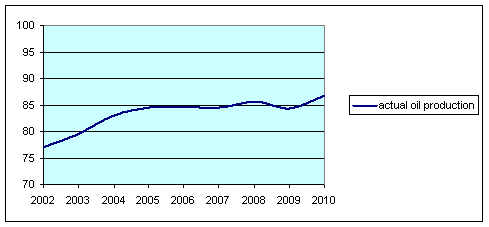
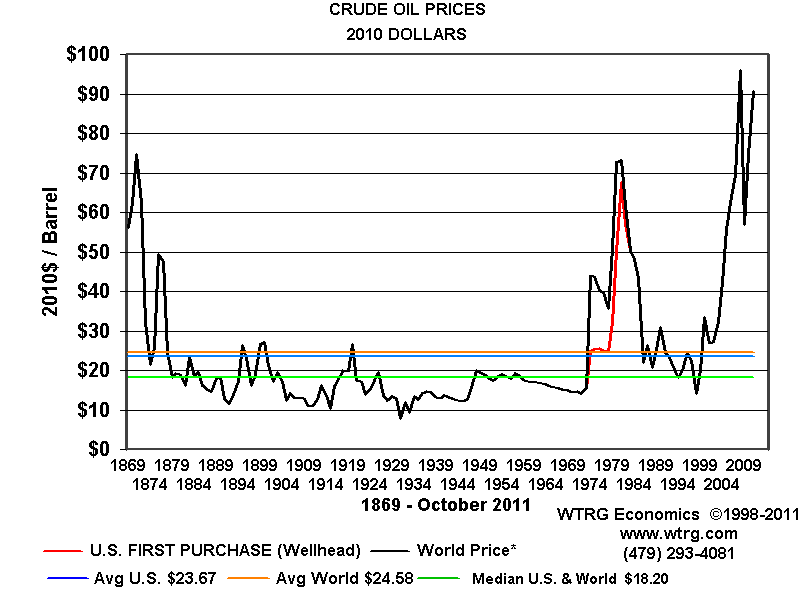
It seems like oil production is on average rather stable, while prices are not.

*


Total global oil production, in millions of barrels per day, annual 2002-2010 (data source: EIA)

With an economy at full swing, the demand for oil grows and so do prices, as production lags. If suddenly oil prices go up, there is a problem. More fuel economical machines are not installed on the spot: the demand for oil stays fixed until some buyers drop out of the market and essentially close shop: a crisis. Prices of products go up, demand for products goes down: crisis. Less demand for fuel.

Also when oil production is under thread (you know, the Middle East), prices will skyrocket, with a serious risk of a recession. As oil production is not very flexible, prices will go up suddenly and come down crashing.

The roller coaster ride in the price evolution are a systemic risk to the global economy. But also to the national economy and the household. I did not do any simulations, but it seems reasonable to put that the economy would be able to hum on more nicely at a predictably and steadily rising price.
This calls for a policy by the government to protect the economy by diminishing the risk posed by petrol price peaks.

Peak oil and global warming.

So what do we do?

We can chose to ignore global warming AND ignore the whole peak oil debate.

In the case of global warming, this will probably not help, as the scientific consensus on it is quite huge and, moreover, if you visit the Alps you can see the glacier’s decline. At a certain stage the warming will impose itself. it will be way to late to stop any of it, but in any case, there will be a need for investments in air-conditioning, roof insulation, storm and water works. Meanwhile, we could expect the oil prices not to come down at the 20 US$/barrel anytime soon, as the whole world seems to be getting out of poverty. With a fast growing demand, even with unlimited reserves, it will be difficult to pump fast enough. As most of the oil sits in dangerous countries, the current roller coaster of prices seems to be inevitable.

A policy trying to limit the impact of oil shocks would even in this case be good policy. Just drilling more would not change the prices a lot, but making the economy as a whole less dependent on oil, or energy if possible, would. What are these measures? The same as what you would do if you believe in global warming.

What kind of society?

If we know global warming is coming and oil prices are expected to go up, an active policy to go for oil and coal independence is urgent.

With the current technology, it might be possible to nurture decentralised systems or go for evermore centralisation. Solar panels on the roof or fusion energy.

Or we could hedge our bets. We don’t want to nuclear power providers get into a powerful position like the Arabs are, so the development of more diffuse power production is a necessity to balance the centralised powerhouses.

Indeed, big oil, big energy and big finance have a similar track record. They wield enormous power. They are able to resist reform, even if the systemic risk becomes too high. Democratic control is often failing.

Concluding, as any response to the increasingly unstable petrol prices will take time, I would agree with Paul that the first ten years of Peak oil will be rough.

Geo-engineering: ready or not, here we go

Climate change is a reality, and it means humans are in charge of the climate now.

Putting carbon in the air used yo be a simple process called cooking, now it is geo engineering, as we know it changes the climate.

Fine tuning our energy use and milk consumption to diminish global warming, is geo-engineering.

Painting mountains white, is the same process of geo-engineering, but using more parameters.

The genie is out of the box. We have to take responsibility.

If only it was so simple that we needed only to look at our carbon consumption. It is a very wide field, with lots of hard choices to make.

We can cut carbon by making heating for the poor more expensive, or we can paint our roads or roofs white. Some choices will have consequences for the most vulnerable, others are untested and might have unintended results. What balance do we want between moral outcomes, environmental risks and social impact?

In the end, these choices should be made as a policy choice, and should not be forced upon us by events.

The last thing we need is a principled stance on what instruments to use while ignoring the moral consequences of the other choices.

Development: The dictator’s handmaiden; Is bad aid almost always good politics?

I have just finished reading the Dictator’s Handbook, by Bruce Bueno de Mequita and Alastair Smith. I immediately reread some chapters. The book gives you an insight you feel you have known all along, but you just could not act upon it because you don’t want to be seen as a spoil sport, cynic and nutcase.

From reading the book, I think adding a power impact assessment (PIA) before committing to development interventions is necessary.

The book makes a very convincing case that political economy, driven by personal interest, is the major motivation for leaders and potential leaders (surprise). The main objective of a leader is to get and keep power. Good public policy is not more than a distraction in this pursuit.  Leaders ignoring their main objective, will have only a short stint at the top.  So the leader will try to get as much loot from the state and its subjects as possible, and pay just enough to his essential backers for them to stay loyal to him. The rest is preferably stashed away for bad times. She must try to rely on as few possible backers as possible, who should each always need to scramble to keep her favor. The formula is really quite simple, but please, just read the book, I will limit myself to ponder some consequences of this reality of power ( “the world like it is, and not how we would like it to be”) on development assistance.

Easterly is an optimist
The Handbook gives a very black view of the world. We all know a politician or leader who would never act this way. The book however comes close to predict the real choices made by most of the world leaders who manage to stay in power (unlike the gullible friends of ours).

This means that development money that is embezzled by the leader and its cronies is not a bug, it is the main feature of cunning leadership. The whole government ownership agenda is very misguided in this light. It is probably true that the local government knows best what can work and what not. However this is not very relevant if the interest of the local leader in development funding is limited to the use of these funds to help her to stay in power.
Indeed: if the objective of the able leader is to keep the money and distribute it only to his essential backers,  anybody who is not an essential backer will not get anything.

It is also a positive message: understanding this mechanism makes it possible to use strategies to change the incentive structure and change the system.

Forget Paris.

Some types  of development assistance will be very much in demand by autocratic leaders.

  • Infrastructure leads to  excellent corruption and patronage possibilities. Moreover, in the form of big dams, it gives the dictator absolute power on who gets power and who does not.
  • Military support is even better. You can pay your essential generals and distribute bribes. Paying the rank and file is optional: they can “harvest” their own salary from the population.
  • Basic services are necessary to keep the population just intelligent enough to work hard. This is only important in countries without natural resources or without big aid flows. Anything beyond primary education will only lead to emancipation and other trouble. The leaders love basic services provided by NGOs: it authorizes the leader to spend less on the poor and more on themselves. Moreover, it transforms education from a right that the government is accountable for, to a gift from a foreign benefactor.
  • Disaster relief provided through the government services. It authorizes the dictator to embezzle most of it, while giving the rest only to the essential coalition.
  • Dept cancellation will only lead to the dictator strengthening her hold. Dept cancellation should be more conditional to democratic reform, or even better, used after democratic reform happened.  Apparently dept cancellation only works in democracies anyway.

The writers seem to have written the Handbook from a very serious concern to improve the effects of development assistance for the real world, not for the world we would all love to live in.

Their main piece of advice on development is to go for “cash on delivery”. Pay a non-inclusive government only for goods and services it has delivered, not for the process. Indeed even simple processes as capturing a terrorist bring in more loot for the cronies if they are dragged on eternally.

From poverty to power

The main lesson  I take from the book is the need to expand the coalition in power. If the leader has to rely on a wider coalition to stay in power, the kleptocracy deludes into a state delivering public services for most of the people. Indeed by growing the coalition needed to reign, there is a tipping point when it is cheaper for the leader to provide public services than to pay a bribe to the ever-growing number of essential backers.

The book goes in detail on the issue of inclusive governance structures, and ways that are used to limit the power of the public to hold leaders accountable. It proves that the nuts and bolts of the democratic system we use matters, and this as well for governing a country as for a public company or even a club.
While in a democracy a Government theoretically needs the backing of more than half of the voters, in reality this is often much less. The writer explores how the leader can find innovative ways to limit the number of people with actual power in different systems. In a multiparty first past the post-system a group can grab power with as little as 10 % of the total population backing them, just by gaming the system.

All this means that we need a radical emancipation strategy to deliver on development, where expanding the essential coalition in a country is seen as the main goal of interventions. Delivering services in non-democratic countries will not lead to a long-term development agenda; widening the coalition to include the middle class and the poor does. If some services must be delivered, theoretically the cash on delivery system should work.

To take home
Power and incentives matter. In the real world, they might matter more than the moral high ground. However, just like the rational choice is too simple to explain all economics, rational dictators are probably too simple to explain power. It is a start, and it would help us to be less gullible.
This is why I propose to add to each intervention a Power Impact Assessment (PIA), just like an environmental impact assessment.

Planning for collapse: making development interventions too big to fail and vulnerable to systemic risk.

The financial collapse in 2008 following the collapse of Lehman Brothers was enthusiastically prepared by the political and economical decision makers. In the 70s and 80s, in the name of more efficiency and free marked, regulations were more and more seen as a restraint on the development of companies. With less regulation, the market would be more efficient with less transaction costs. The firewalls between savings and investment were torn down, as the memories of the thirties were deemed irrelevant and “this time it is different”. Indeed economic growth followed. Financial markets seemed more efficient. The business cycle seemed to have disappeared.

Companies became more and more interlinked and financial products became more sophisticated. Risk was shared among more actors, all of them with a AAA rating. The risk vaporised in the system. Until it suddenly was there again. The dew point was reached. And the lack of firewalls took down the system, including some governments who believed the hype, like in Iceland and Ireland. As I am not an economist, I would like to refer to Tim for a better explanation of the crisis. His explanation in his book “Adapt” is enlightening and suits my point well.

So the financial system became so integrated that risk became systemic. All actors were linked up so much that the failure of one hurt all of them. The financial innovation went so fast and the system became so complex that nobody could assess the overall risk anymore.

Development is a risky complex system.
Development is a risky business. Success is elusive and failure frequent. Moreover the “transaction costs”, the difference between what the donor wants to give, and what the ultimate recipient gets, is high. There are important inefficiencies: unaccountable partners, overlaps, gaps, lack of results, lack of knowledge what works and what not, not forgetting stubbornness in repeating things that failed over and over again like swedow.

The way to make changes in a complex system is best described by “do no harm”: a prudent and evolutionary approach. Make small changes, and with a short feedback-loop check on the effects on the system as a whole. Make another change. Innovations should be never too big too fail. Innovation should be tested before bringing it to scale. Indeed, this is our world, our ecosystem. We should not take systemic risks with the lives of poor. As it is impossible to predict what will work or not, it is better to have a lot of initiatives and not to pre-empt the outcome.

A development system based on these principles should be expected to be very conscious of the risks that go with large-scale intervention, and focus on the value chain from innovation to bringing to scale.

The development system that exists however has the Paris agenda and the humanitarian cluster approach. The 3D approach (development, diplomacy and development), linking relief to development and integrated missions. The items on the international agenda are aiming to link the different systems to each other. Does this lead to more efficiency or to unacceptable systemic risk?

Some examples where this clustering of agendas seems to have led to collapse due to systemic risk: :

  • In Afghanistan the West has tried the 3d approach, it did not seem succesful.
  • In Uganda, donors have linked themselves into a budget aid logic, meaning that to punish the parliament for a gay law, children will probably not get their vaccine anymore.
  • Madagascar textile lost their jobs, because the duty free regime for their country was withdrawn after the politicians squabbled too much.
  • In DRC and Sudan, the UN integrated missions make the UN-humanitarian agencies de facto not neutral, affecting their efficiency in a serious way.
  • In Somalia the mixing up of the humanitarian and anti-terrorism agenda was an element in the current crisis.

From these examples I would like to conclude that systemic risk for the whole aid effort in a country can exist if agendas are lumped together. If an approach does not work, the most logical explanation could be that the approach is not a good one, and different options must be explored. The alternative narrative, that it did not work because we did not try rigorously enough, seems dangerous.

An alternative: nimble aid (agile aid, mindful aid)
Nimble aid would consist of independent interventions, each very limited in its objectives and conscious about the unpredictability of externalities. Like a bird in a flock, each programme would be able to steer itself in full consciousness of the effects it has on its environment. It is the evolutionary approach to development. If every objective is diluted in a wider technocratic programme, nothing is really happening. Trying to be responsive in a wider programme just leads to more meetings and more lemming thinking on development.

Vaccination programmes in humanitarian settings do just that: saving the life of thousands of children, leading to healthier and more productive lives for the beneficiaries. An effect that can be traced over up to 100 years.
New agricultural practices are tried one by one on a small scale, until there is one that works well, and everybody adopts it. Like the use of maize in Africa, long before colonisation, and varieties resistant to plagues now.

It is a development agenda which is less ambitious in the short term, but revolutionary in the long term.

A prerequisite for this approach to work is information sharing. Not information about what happened, but information on what is happening. So all actors know what others do by reading this information and can adapt their interventions to what is already happening around them. The actors can only correct their actions if they know what is happening around them. This is very much like obliging public companies to publish essential information , development actors should to post essential information on their activities. Information sharing should not be confused with going to meetings nor coordination.

Keeping the firewalls
In the consensus thinking, a compounded indicator will tell you about success of failure (like the human development index). This means that each value, each objective is not important enough to fight for on its own. You want to raise the overall index. In a nimble approach there is a tension between overall goals and each objective. There is a specific programme assuring that child mortality is down. Even if the government does not have the institutions or intentions to do it themselves yet. Good child mortality work will always strengthen the local institutions when the objectives are both long-term and short-term.

This is why I would like to argue to keep the firewalls between the values that are important. This does not mean to work in an ivory tower, It means that there are some objectives you just don’t negotiate away.

Moreover: fund what works
There is a lot of evidence on interventions that do work, even on a large scale. Getting rid of funds is not a problem for the agencies even if they would limit themselves only to evidence based interventions. Just a few examples that work in some circumstances if done well:

  • Basic economical infrastructure
  • Basic health services
  • Cash support for the poorest
  • Water and sanitation
  • Most humanitarian interventions if done according to the Sphere Standards.

And so much more. In the cases of decent accountable local institutions, even some forms of budget aid seem to work.

In conclusion

Of course, coördination and coherence are important. But they are only means for reaching results. Sometimes other means, like innovation or competition, might work better. When coherence becomes an objective of the aid, however, the level of systemic risk for the development system might just be too high.

Finally, transparency will always be beneficial for planning interventions, as well in a coherent as in a competitive environment.


Admitting Failure: Join the Posse (Only for real Men)

I am all in favour of evolution in development practice and thinking, where normally, it is more important to cull downright dismal failures than to select only the best, as evolution needs variability to work its magic.

Admitting mistakes or difficulties is also part of every professional relationship between partners. Part of the reputation of ICRC is generated by its tendency to speak rather bluntly about its own capacities in private, while the toeing of the party line by the staff of other organisations (say UNICEF) lessens the confidence in the organisation. However, when looking at the public image, it might be the other way round. It might seem that, when you need direct funding from the broader public, admitting failure is not the best practice.

I have some serious questions on the trend to focus on admitting failure. I will focus on elements:

  1. Who can admit failure?
  2. What does this failure say about the respect organisations have for beneficiaries?
  3. The posse rides again, where do we ride it to?

Who can admit failure?
When I look at who is leading the charge in “admitting failure”, it seems to me that big failures can be admitted by organisations who interact mostly with a more sophisticated donor public: governments (World bank) or better informed people (who supports engineers without borders?). For these organisations it seems to me to be fully in line with the analysis of Marc: it is just something to run with the posse, without a real cost. It is signaling credibility. However, if they need a separate thematic line to treat with failure, what have their (transparent) evaluation and monitoring departments been doing until now? An aspect that cannot be addressed with the failure approach is the recognition that systems are inherently complex.

When other organisations publish failures, it is closer to a “lessons learned” story: we know this works, we applied it there, we overlooked this element, it did not work). What is being talked about by these organisation is not failure, but evaluation and short feedback loops, in order to be able to correct early in the project. Small NGOs don’t have official evaluation strategies, they just learn their lessons the hard way, and take them on board.

Admitting failure looks very much like extremely badly conceived monitoring and evaluation when described this way. Indeed I fear this failure posse might interfere with the other posse towards professional and transparent evaluation and results measurement. The World Bank should know better.

Please some respect
The stories about failure often describe projects that were implemented and afterwards it seemed not to work, because of a simple aspect not taken on board. The Merry-go-round water pump is the case in point. I notice that the evidence base of this project was weak, and implementation at a large scale happened before a decent assessment was made.

This echoes the discussion on the Millenium Villages in the Guardian where do-gooders rush into implementation of everything they think will help the villagers, claiming it would be immoral to let them wait until an evidence base is established. I sympathise with them, but a minimum of monitoring must be possible between a pilot or startup phase and full-blown execution. Of course, the victims of all this activism are poor, and poor are by definition powerless. The organisation can just move on, looking for fresh victims. There are enough of them : “the poor will always be with you”. With enough failure, we can assure they stay that way.

The posse rides again: where to ?
Failure looks to me like the spin off from a good tendency. The tendency to professionalism, to stop looking at the world as it should be, but as it is. The need for evaluations and feedback loops. The need for research and evidence base. The need to document what works and what not. Part of this professional approach is that failure is just another piece of transparent information from every actor.

However, like we saw the “program approach” coming instead of making good projects, it might be that the Posse on Failure attracts more riders than the one of professional information and risk management.