- The Best Dishes of 2010 – NYTimes.com – The 15 best things The Times’s restaurant critic ate in New York City in 2010. Enjoy!
- Iraq Encounter – Watching a Faith Healer at Work – NYTimes.com : Patient-focused treatment impresses an American psychiatrist. Am I being too negative about traditional healers? In most cases I met, traditional healers were rather a force against development than a force for empowerment and healing.
- Dear Mr. Gandhi, We regret we cannot fund your proposal… – The fear of anyone doing project assessment and funding. Gandhi would not even come close.
- The Story – Blood and Milk; […] It’s because my views don’t match the media narrative about development – the meta-story. And unless you’re done an unusually pragmatic course on international develop…This gap between meta-stories is, I think, one of the central problems in development and humanitarian aid. How to ride the story? (Moreover, also in immigration and policing the meta-story in the media is quite different from the story among academics).
- Women and alcohol – Marginal Revolution; Is there a better blog post title? Are these just accidental correlations? A good diner table subject in any case.
- Sachs: America’s Political Class Struggle – Economist’s View; Jeff Sachs says the “level of political corruption in America is staggering,” and that “powerful forces, many of which operate anonymously under US law, are working relentlessly to defend those at the… Go for it, Jeff. Someone acknowledging the reality of power struggle and class warfare is rare today.
- Ten Provocative 2010 Studies in Positive Psychology – The Essential Read; It is easier to have the best studies grouped together then reading the blog for a year to stumble upon the rare nugget. .
- Year-End Report From Charity Navigator’s President & CEO – Charity Navigator ; 2010 was the year that charity assessment became mainstream with the Haiti and Pakistan crisis. If this is so, a major leap in quality and bang for buck is expected.
- Bundle Up, It’s Global Warming – NYTimes.com – www.nytimes.com; Why is it so cold and snowy in Europe and the Eastern United States? Global warming is affecting the snow cover in Siberia.
- Looking Back on Haiti – III: Crisis of Purpose, Crisis of Practice – Tales From the Hood ; As we near the one-year anniversary of the most devastating and most visible rapid-onset natural disaster in recent memory, I’m publishing a short series of posts looking back on the Haiti Earthquake Response. This series is not meant to be the definitive word on “Haiti.” There is certainly much that can be said and probably […]; We are good at repeating mistakes? Early in the crisis, the fragmentation of the state by the NGOs was seen as one of the long-term development issues for Haiti… now it is a humanitarian issue as well. So many years after the Tsunami.
- Gauging Bill Gates’s Health Grants Five Years In – NYTimes.com – www.nytimes.com; Of the Bill & Melinda Gates Foundation’s $450 million in grants, Mr. Gates says, “We were naïve when we began.” But they are ready to learn.
- Signs that your targeting strategy is working… – Chris Blattman For our street youth project in Liberia, the aim is to see how environment, time preferences and credit constraints contribute to poverty and instability. We then (experimentally) introduce… If push come to shove, it are the small pilots and studies with people in real trouble that I find the most exciting, even knowing this will not change much in “the grand scheme of things”.
- Power from the Manger – Aid Watch; Caesar Augustus was the greatest Emperor of the greatest Empire. He could force the whole population to move back to their ancestors’ villages just to pay their taxes. Herod was governor of Judea, a… Is Wild Bill a hooligan or one of those old-fashioned romantic revolutionaries?
- Obama’s Other War – By Joe Bavier | Foreign Policy – The LRA terrorism might be easier to solve than the other kind; if only we would try as hard.
- Scientifically, You Are Likely In the Slowest Line – Slashdot; “As you wait in the checkout line for the holidays, your observation is most likely correct. That other line is moving faster than yours. That’s what Bill Hammack (the Engineer Guy),… The article gives the final answer to this long-standing problem. Just resign to your fate.
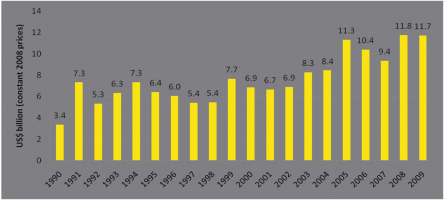
- Humanitarian aid in 2009: headlines from the latest DAC data release – Global Humanitarian Assistance » Blog; Old data, as 2010 was on the humanitarian side more exciting. The relationship between needs and donor budgets merits a closer look.
- “Is Theoretical Physics Becoming ‘Softer’ than Anthropology?” – Economist’s View; A compelling story: Anthropology and sociology indeed are becoming increasingly evidence based.
- Elections to Watch in 2011 – By Max Strasser – Foreign Policy; From the U.S. midterm “shellacking” to the sham vote in Belarus, elections provided some of the most memorable moments of 2010. And 2011 promises to be no different, with contentious polls coming up in ascendant Turkey, stagnant Egypt, fractious Sudan, and more.
- The Humanitarian Appeal 2011: Any Progress? – Global Humanitarian Assistance » Blog; I imagine we would agree that one clear way of measuring the progress of humanitarian assistance is when it is not needed anymore. In ten years time if we are spending US$15 billion (a fairly conservative estimate given recent trends) on humanitarian aid year on year we are surely making a mistake. We will not have made the right choices about how to spend what is a finite resource: money. Doe…
- Visibility is not the same as transparency – Owen abroad; I still have my doubts if just getting the data on line will solve the main issue of allocating resources for better results. The selection process is where evolution takes place and it is still mostly a black box.
- The Global Gay Rights Battlefields – By Max Strasser – Foreign Policy; Don’t Ask Don’t Tell might be finished in the United States but, in many countries, the fight for gay equality has far bigger challenges to overcome
- Climate: Is a Big Technology Push Really Enough? – Global Development: Views from the Center; By Nancy Birdsall – I’ve been mulling over this problem ever since I finished this paper with Arvind Subramanian. We conclude that to deal with the climate change threat to human well-being and livelihoods as we know them today requires an extraordinary technological revolution – not just reducing carbon content but completely eliminating it, i.e. completely severing the link […]
- “Sunshine: at the IMF, of all Places” – Economist’s View; A new paper argues that the best solution to a financial crisis like the one we just experienced is to increase the share of income going to labor: Sunshine: at the IMF, of all places, by Alex…
- Where Does Hate Come From? – Economist’s View; Daniel Little has a question: Hate as a social demographic : Every democracy I can think of has a meaningful (though usually small) proportion of citizens who fall on the extreme right by any standard: racist, White supremacist, hateful, anti-immigrant, anti-Semitic, anti-Muslim, nativist, nationalist, or violently anti-government individuals and groups. In the United States we have many, man…
- Palestinians Must Be Free – By Ambassador Maen Rashid Areikat – Foreign Policy; Ignore the smoke screen thrown up by Israel and its apologists. The real reason for the lack of an enduring Mideast peace deal is the Israeli occupation.
- The march of freedom – Aid Watch; All men are created equal. Except blacks. Except women. Except gays. American history shows the erosion of the Excepts, although never complete. Yesterday’s repeal of Don’t Ask, Don’t Tell was another small victory for freedom. Let’s celebrate, while never losing resolve to keep moving towards complete equality and liberty for All. Why even homophobes should celebrate gay rights victories – Aid Watch; One of my favorite Abraham Lincoln quotes: As I would not be a slave, so I would not be a master. This expresses my idea of democracy.If I claim the right to deny you rights, that sets the precedent…
- Freedom from fear: Protecting people from one of the world’s most brutal rebel groups – From Poverty to Power by Duncan Green; Maya Mailer, Humanitarian and Conflict Policy Advisor Across central Africa, men, women and children live in fear of the Lord’s Resistance Army. This predatory group attacks women as they perform their daily tasks – fetching water or tending to their fields – and children returning from school. It abducts, mutilates, rapes and kills, using extreme violence against the most vulnerable. Surviv…
- Assessing Humanitarian Aid – Global Development: Views from the Center; A lot can be said against the methodology DARA uses, and even against the results they publish (honestly, New Zealand doing better than the Netherlands?). However, the index is necessary and useful. Subscribing to principles, without creating a cost to the non-compliance is moot. DARA makes it worthwhile for a donor to comply, as non-compliance leads to dismal scores. Countries should get more detailed feedback, as they need to be able to explain the problems caused by the methodological issues, and address those that are caused by the lack of motivation to comply with the undersigned principles.
- Local politics a tough nut to crack – Chris Blattman; Donors push “community driven development” programs largely to strengthen local institutional capacity, democracy, and inclusiveness. (Sometimes overlooking the fact that these three goals are not…
- Development Policy Review, Theme Issue: Aid, Institutions and Governance – What Have We Learned – Resources – Overseas Development Institute (ODI) – www.odi.org.uk; As part of ODI’s 50th anniversary celebrations, DPR has republished nine key articles in the field of aid, institutions and governance, with an introductory essay by former Editor David Booth.